Sunday, February 20, 2011

Matthew E. Eagleton

The distinguished-looking man in the back row of the 1913 class at Garden Place School is Matthew E. Eagleton, principal from 1901 - 1920, and one of three Eagleton brothers who devoted their lives to schools in Denver.* When he began his career in 1901, Eagleton was in charge of three schools Argo, Globeville and Garden Place, driving a horse and buggy from one school to the other. 
Eagleton was respected by the immigrant community, helping parents with the process of Americanization and holding citizenship classes in the evenings. The teachers at Garden Place admired "Mr. Eagleton, who did everything in his power to make things easier for us...getting supplies and books." He inspired teachers to fill the educational gaps for children who were out of school for several months to work in the beet fields. When Globeville's German-Russian population came under suspicion during World War I, Eagleton defended their patriotism, reminding public officials there were "72 service stars on the service flag, two of which are gold." Matthew E. Eagleton died in February, 1920, leaving his widow (and Garden Place teacher, Maude Long) and a grateful community.
*Brothers J. S. and W. H. Eagleton were also educators and principals in Denver.
 History of Garden Place School, typed manuscript 1950
1913, Picture used with written permission from Maxine DeDonato


Tuesday, February 1, 2011

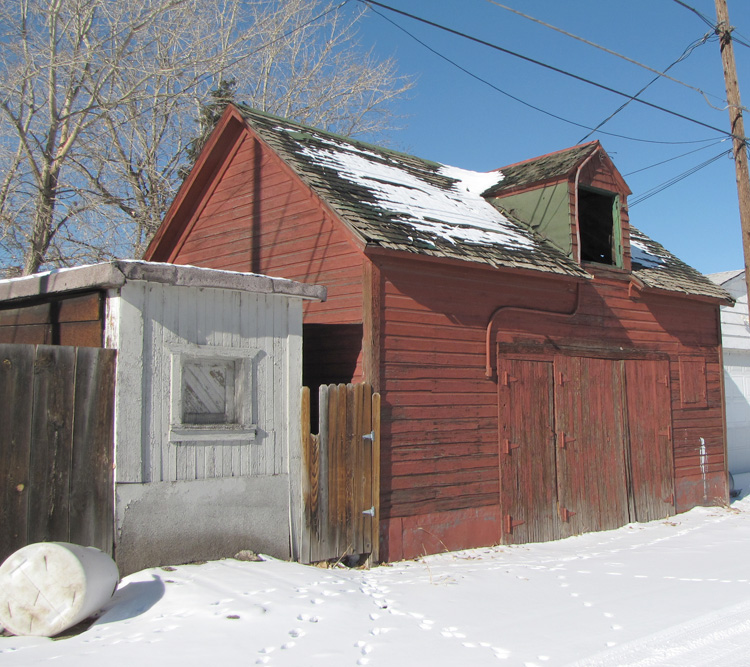
Barns and Sheds

Early Globeville was more rural than urban and many people built a barn in the back for chickens, geese, cows, horses, wagons and storage. Lumber as well as paint could be obtained at the nearby Burlington shops, giving these buildings a distinctive look - tongue and groove wood painted "railroad red." As Globeville evolved, so did the use of these outbuildings - from barns to garages, workshops and mother-in-law apartments. Many of these structures survive - a tribute to the craftsmanship and enterprise of the pioneer builders, and an additional bit of charm in a neighborhood with personality to spare.


Photos, Mary Lou Egan

Saturday, January 15, 2011

Wolgagesangbuch

There were three German-Russian churches in Globeville whose congregations were composed (mainly) of people who from the same villages in Russia. The Congregational Church was founded by immigrants from the village of Norka, St. Paul’s Church by people from the village of Beideck, and the Friedens Evangelical Church by people from Doenhoff. Though belief varied a little, all three congregations used the same hymnal, the Wolgagesangbuch, with hymns being a conspicuous and important part of worship.

Lydia Heck remembered, “They were long songs, sometimes fifteen verses, and people knew them by heart. Those books had the words in them, but no music.” John H. Werner recalled, “I believe most of the people knew practically all of the 878 songs in the book from memory! Some of the favorites that come to mind are: Allein Gott in der Hoeh, Christi Blut, Ein Fester Burg Ist unser Gott, and Jesu, Geh Voran.”
With prosperity and assimilation, the German-Russian population of Globeville moved away from the neighborhood, but their descendants inherited their faith - a faith based on the Bible, a personal relationship with God and a simple lifestyle.

Wolgagesangbuch courtesy of Virginia and John Laber

http://heritagecommunity.net/
www.ahsgr.org

Sunday, January 9, 2011

Developments at Holy Rosary Parish

Red, white and blue bunting emphasizes that the Slovenian and Croatian immigrants are loyal to their new country, while lodge banners proclaim their determination to preserve the heritage of the home country. The stack from the Grant Smelter looms over the Globeville neighborhood and women hold umbrellas to ward off the hot sun. August 17, 1919 was the day on which the cornerstone of Holy Rosary Church at 4688 Pearl Street was blessed by Bishop J. Henry Tihen "in the presence of a great crowd of rejoicing people." These immigrants were proud of their new parish and devoted their time, treasure and talent to the church. Founding pastor, Father Cyril Zupan, O.S.B., was responsible for both Holy Rosary Parish and St. Mary's Parish in Pueblo, which meant a two-hour train ride each way to say Mass, administer the sacraments and supervise construction.

90 years later, the parish faces new challenges. Pastor Noé Carreón is charged with the task of restoring the church, convent and school and rebuilding both English-speaking and Spanish-speaking congregations. Although the task is great, Father Noé, the parishioners and the neighborhood are excited to see the progress that has been made.
The parish invites you to follow our journey on our blog/website at:
http://holyrosarydenver.com


Friday, December 24, 2010

Christmas postcards 1910

These postcards are to and from family members and are dated 1910. The printing is beautiful with gold ink, complex graphics, many colors and some embossed surfaces. The message side is often used as we would use a phone call "will arrive by train on Thursday" or "please send a money order." Some notes are surprisingly personal and tender, considering how visible the content would be: "missing you tonight." Denver was much smaller, too. One card is simply addressed to the Globe Mercantile, Globeville and apparently arrived there alright.

Friday, November 26, 2010

45th Avenue Pharmacy


This photo used with written permission from Lauren Summers, grandson of Carl Gerhardt
Ex-Lax, ice cream, fountain service, Coca Cola, 7-Up - the details in the photo of Heck’s Pharmacy on 45th and Sherman tell the story of another era in Globeville.  Unlike the quick, one-stop retail shop of today, the drugstore looks like the kind of place you might like to hang out. Lydia Gerhardt Heck remembered, "My husband worked at the drug store on the corner, and we lived next door. The depression years down in Globeville were very hard and it was nip and tuck for a few years. When liquor came back in 1932, he got an alcohol license and that helped him pay the rent and kept him going until the war. During the war, everybody went to work, made big money and spent money and then he did OK."

Bottom photo used with written permission from Lauren Summers. The man with the hat is Carl Gerhardt, Harry Heck’s father-in-law.
Top photo, the same location in 2010, Mary Lou Egan

Saturday, November 13, 2010

Argo Park

The Rocky Mountain News described Argo Park as “…a delightful retreat on the banks of the Platte…whose grounds have been prettily laid out… a charming suburban retreat.” The occasion was the dedication of the park on July 25, 1880, a decade before Globeville existed as a town. The park, which extended from Logan Street on the West to Washington Street on its eastern edge, was intended to serve the residents of Argo, the company town built by the Boston and Colorado Smelter, as well as the citizens of Denver. Philip Zang purchased the “resort” in January, 1885 and made improvements that included a theater, dance pavilion, bowling alley, ball fields and a small zoo. The park was home to the Strawberry Festival, picnics, band concerts, athletic activities, community gatherings and “pleasure parties of all kinds.”1. Welsh workers from the Boston and Colorado Smelter held annual eisteddfods, or singing contests, in remembrance of customs in their native land.
Martha Kulik Birch remembered, “It was one block square and they had a dance pavilion with an orchestra. People used to work hard all week and then come on the streetcar and dance under the stars. 
In the summer, there were swings, sandboxes, and a little cement wading pool for us kids. When I was about nine or ten [1917], we had this wonderful, husky teacher named Mrs. Roosevelt who wore a middy blouse, a big skirt, and carried a big whistle. We kids never ran wild because everyone obeyed her. She showed us how to make baskets by soaking rattans, and at the end of the summer, we each had a little basket.”2.
The park diminished in size as various owners sold parcels for development, and became part of the Denver parks system when Globeville was annexed in 1902. As part of the New Deal, a swimming pool and changing rooms were added in 1940, and a memorial honoring Globeville veterans killed in World Wars I and II was dedicated on August 25, 1948. More recent improvements have included a lighted baseball and softball field, basketball court, playground, and picnic tables. The pool underwent $1 million in renovations in 2005, a “sprayground” was added in 2007 and walking path in 2014.


1. Rocky Mountain News, July 25, 1880
2. An interview with Martha Kulik Birch with her niece Debbie Strein.
3. Fell, James E., Jr. Ores to Metal: The Rocky Mountain Smelting Industry. Lincoln: 
University of Nebraska Press, 1979
4. www.recreationparks.net/CO/denver/argo-park-denver
Top photo, Miss McCammon taught the third and fourth grades - 
photo of her class taken in 1914 with the dance pavilion in the background. 
Photo used with written permission from Minnie Boge Herbert.
Middle and bottom photos, Argo Park today, Mary Lou Egan