Friday, June 4, 2010

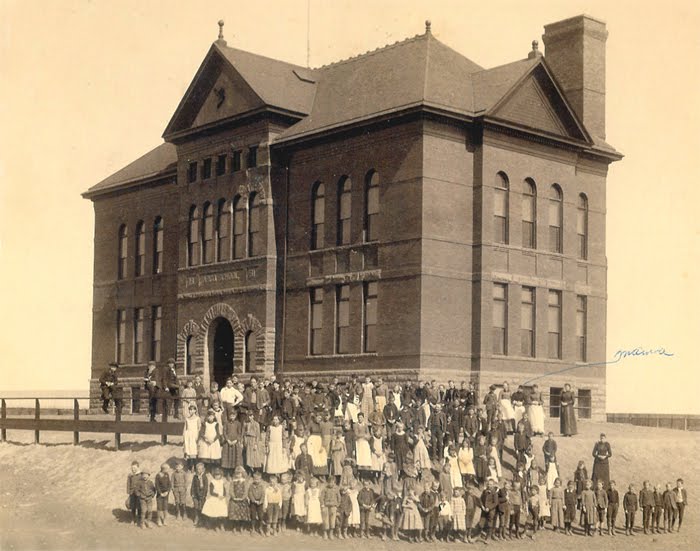
The Globeville School


Three large smelters, the Boston and Colorado, the Omaha and Grant and the Globe, operated in Globeville between 1878 and 1889 and workers moved to the town seeking jobs. As the population grew, the region evolved from a rural outpost to an industrial village and the small country schools that dotted the area became inadequate. The Globeville School was built on the corner of 51st and Washington in 1890 on land belonging to the Globe Smelter, replacing a one-room country school that had been on that site since the 1870s. The community continued to expand and a new and larger Globeville School was completed in 1925 at 51st an Lincoln. However, the increase in the population reached its high point in the 1920s and declined afterward. With a dwindling enrollment, the Globeville School closed in 1943 and the remaining students were sent to Garden Place School.
In 1948, the building was given new life when Joseph and Elizabeth Calabrese created Laradon Hall, an organization that offers support, guidance and training to children with developmental disabilities.
Top photo, Globeville School at 51st and Washington, 1890, photo Denver Public Library
Second photo, Sam's Vintage Parts occupies the remains of the 1890 school, photo Mary Lou Egan
Third photo, new school 51st and Lincoln 1923, photo Denver Public Library
Fourth photo, Laradon Hall today, photo Mary Lou Egan

Wednesday, May 12, 2010

Argo School


At the time of Globeville’s incorporation in 1891, four elementary schools, Argo, Ironton, Globeville and Garden Place, served the area's children. The Argo School was built in 1890 for the children of the company town known as Argo, home of the Boston and Colorado Smelter. The school was richly endowed with funds from the smelter and the railroads and embodied all that was modern in its day: toilets that flushed, a basement, and a furnace. The school also housed the office of the superintendent, who was responsible for all four schools.
After a fire destroyed the Boston and Colorado Smelter in 1906, the population of the town diminished, the smelter was dismantled, and the school torn down in 1916. The convergence of interstate highways known as the "Mousetrap" occupies the site of the once-massive smelter, and the Plaza Hotel (now the Quality Inn) at 48th Avenue and Broadway occupies the site of the Argo School.
Photo of the Argo School about 1891 courtesy of Nora Landberg Duryea.
Photo of Plaza Hotel, Mary Lou Egan.

Tuesday, April 20, 2010

Calling all students of Holy Rosary


Holy Rosary Parish at 4688 Pearl Street in Globeville would like to reach out to all former students and graduates of Holy Rosary School, which was in operation from 1929 to 1969. The parish is creating a photographic history of the former school that will be available on a DVD.
The building was heavily damaged when water pipes broke in November of 2008 and work is underway to restore and reopen the school as a parish center for meetings, celebrations, receptions, classes and pancake breakfasts.
Call the parish at 303-297-1962 or email at holy.rosary@live.com.
Or as the sisters would say, you could join us for Mass, 9 am weekdays, 5:30 pm on Saturday, 8 and 10 am on Sundays, 11:30 am Sunday Spanish Mass (starting in May).
Top photo, the school in April, 2010 by Mary Lou Egan
Bottom photo, graduating class of 1938, from June Jackson Egan
Back row, left to right: Frank and Harold Krasovich, Leo Pollock, John Marolt, Bill Mauser, Joe Shaball, Mark Davidovich, Anthony (Nixie) Mencin
Front row, left to right: Mary Drobnich, Mathilda Horvat, Dorothy Kvas, June Jackson, Monsignor Judnic, Eileen Butler, Anne Horvat, Betty Ann Zalar, Sophie Pacheco.

Tuesday, April 13, 2010

The Sidewinder


If buildings could talk, the Globe Hall at 4485 Logan Street in Globeville would surely have some tales to tell. In January, 1894, the building was home to the Golobvich and Slogar Saloon where a group of men gathered to form Sveti Jakov, St. Jacob’s Croatian-Slovenian Benefit Society, an ethnic fraternal insurance organization.
St. Jacob’s was a somewhat secret society for men only, and a password was required to gain entrance to a lodge meeting. The first year the password was “Sloboda” and the next year it was changed to “Hrvatska.” In April 1906, the women of Globeville, mostly wives of St. Jacob’s members, formed St. Ann’s Lodge 143, which merged with the men’s group in December, 1926.
Later, the tavern was called the 16 to One Exchange and was managed by the politically powerful Max Malich, known in Globeville as "the King of the Slavs." The site was home to weddings, funerals, meetings of the town council, and, during the bitter labor battles of 1903, the Mill and Smeltermen’s Union. Meetings to organize Holy Rosary Parish, as well as Mass and confession, were held there until the church was completed in 1920. After World War II, members of the Globeville Veteran’s Association gathered in the tavern for support and camaraderie.
Stop by the Sidewinder, enjoy a beer, watch the Denver Broncos and toast the former patrons of this historic place.
Top photo Mary Lou Egan
Bottom photo, funeral of Martin Kapsh in 1895, courtesy of Alma Mandarich.

Tuesday, March 30, 2010

Easter Blessing at St. Joseph's


Easter basket waiting for a blessing

Swieconka (sh-vee-en-soon-kah) is one of the most enduring and beloved Polish traditions in which baskets containing a sampling of Easter foods are brought to church to be blessed on Holy Saturday. The basket is traditionally lined with a white linen or lace napkin and decorated with sprigs of boxwood (bukszpan), the typical Easter evergreen. Other items in basket may include sausage (Kielbasa), Easter rye bread, (symbolic of Jesus, the Bread of Life), cheese, horseradish and intricately decorated pasanky eggs.
The traditional blessing of food baskets will take place on Saturday, April 3rd at St. Joseph's Polish Church at:
  • 10:00 am
  • 12 noon
  • 2:00 pm
  • 5:00 pm
5 pm service followed by Mass in English: 8:00 pm in Polish.
St. Joseph's Polish Catholic church is located at 517 East 46th Avenue in Globeville.
http://www.swietyjozef.org/

Tuesday, March 23, 2010

Zvelichar


"Zvelichar nash je vstal od smrti...Sing joyfully o Christian, because today on Easter is the day of your joy." For many years, this Slovenian hymn was sung during the procession on Easter morning at Holy Rosary Church, a parish founded by Slovenians and Croatians in 1919. Leading the procession would be a strong man carrying the statue of the Risen Christ, followed by children singing Zvelichar and carrying palms.
Today's congregation consists of older Eastern European parishioners and younger Hispanic families. This year's traditions begin with:
  • Mass of the Lord's Supper at 6:00 pm on Holy Thursday, April 1st
  • Service of the Lord's Passion at 3:00 pm on Good Friday, April 2nd
  • Easter Vigil at 7:00 pm Holy Saturday, April 3rd
  • Easter Mass at 8:00 and 10:00 am, Sunday April 4th
For more information, call 303-297-1962 between 9:00 am to 1:00 pm Monday through Friday. Holy Rosary Church is located at I-70 and Washington at 4688 Pearl Street in the Globeville neighborhood.

Friday, March 19, 2010

Orthodox Easter Traditions


Helen Kohut Capron grew up across the alley from Holy Transfiguration Cathedral and had fond memories of traditions during Lent and Holy Week. Helen elaborated on Lenten practices. “For seven weeks, no meat and no dairy (butter, milk or eggs) were allowed, and there were a number of extra church services in each week culminating with Holy Week.
"On Good Friday, there were three services. One in the morning and one at three o’clock where people fixed the grave. Friday evening was a burial service, “Plashtanitza,” that featured a shroud with the figure of Jesus on it and flowers all around it.”
“There was a service on Saturday morning more like the resurrection, when all the purple fabric that covered everything during Lent was removed and the priest changed into white vestments. On Saturday night, they would do part of the service, and then everyone left the church with the priest and his servers, who circled the church three times. During that time, people inside the church took the grave away and put everything back in place. When the priest made his third circle, he came to the door and knocked and that was a symbol of the resurrection. Then the people went in to begin the Liturgy, the Easter Mass. So the Easter vigil service began at about 11:30 at night and continued until about 2 in the morning.”
“It was always the custom to bless the food people had prepared for Easter. And so people would bring their baskets of food to the church hall. It was always a big deal because, if you had fasted like you were supposed to during Lent, with no meat and no dairy, it was very special. Sausage, eggs, fruit, ham, butter cakes - everything you could think of was in those baskets. Our family had a big wire basket and it would take two men to carry it across the alley, it would be so full. The baskets would all be in the church hall and, right after church, the priest would bless them. Then people would go to their homes. Nowadays, people sometimes partake of the baskets right after the blessing and go home about 5 o’clock in the morning. On Easter morning itself, there was a short service right after the Liturgy about 11 or 11:30.”
For current Lenten and Easter services at Holy Transfiguration Cathedral, visit http://www.transfigcathedral.org