Showing posts with label Slovenian. Show all posts

Wednesday, September 18, 2024

Homecoming at Holy Rosary • October 5th, 2024

This October 5th, Holy Rosary Church in Globeville will host our fourth "Homecoming" event.

If you've attended any of our previous gatherings, you know how much fun we had visiting and sharing memories. If you haven't been to Homecoming, you'll want to join us and invite your children and grandchildren to come with you.

We'll begin with Mass at 10:00 am in honor of the feast of Our Lady of Holy Rosary in our century-old church. There will be a few traditional Latin hymns (Can you remember the Tantum Ergo?), Slovenian and Spanish hymns. The stunning stained-glass windows, statues, and stations of the cross are a testament to the devotion of the church founders.

After Mass, we'll enjoy coffee, beverages, Potica, fruit and sandwiches while folks rekindle old friendships and make new ones. Bring those photos of First Communions, choirs, pageants, bingo night, posadas, quinceañeras, Our Lady of Guadalupe processions, pancake breakfasts and Christmas programs. Check out the 41 graduating classes from Holy Rosary School and see if you can find your relatives in them. Check out the classrooms - which teachers do you remember?

At our three previous Homecoming events, people shared their memories of teachers, classmates, events and antics in a video. There will be a video set up to record your favorite story about Holy Rosary!

Saturday, October 5th 2024 at Holy Rosary
4688 Pearl Street  •  Denver, CO 80216
Mass at 10:00 am  •  Refreshments, fellowship and sharing
RSVP (so we'll have enough food):
Mary Lou Egan  •  303-584-9812
maryloudesign@comcast.net

For updates, see www.holyrosarydenver.org
https://www.facebook.com/HolyRosaryChurchDenver


Wednesday, August 23, 2023

Obituaries


Lucille Korsich and Louis Vuksinich
 

I read the obituaries every chance I get. Online, and always, the big edition in the Sunday newspaper. It's a family pastime.

My mom would call my brothers, Bill or Joe, or my sister Susan, or me, and if the purpose of the call was to notify someone of an obituary, there would be no small talk. Mom would start right in. "Lucille Vuksinich died." Then there would be pause while she collected her "data." And I would make myself comfortable and wait for the litany of facts: who the person was, where their family came from in the old country, where they live in Globeville, who they married, how many children they had and what our family connection might be.

Mom continued, "Lucille was a Korsich and we're related somehow. Her father was Leopold, 'Polde' they called him, and he and grandpa and Anton 'Tony' Kumar all came over together from the same town in the old country and settled in Globeville and worked for the Globe Smelter. And Polde married Teresa Gerbic - they'd known each other in the old country but they got married in Globeville.

"And they had five children, two boys - Leo and John, and three girls - Mary, Rose and Lucille, and Lucille was the youngest.

"Now Lucille was older - she was 36 - when she married Louis Vuksinich. And they probably met at St. Jacob's Croatian Hall or the Slovenian Home. And they just had the one son, Larry.

"Lucille went back to the old country, all by herself. It was after Louis had died and it was Yugoslavia then. And she stayed for three weeks with the Korsich family. And then they kept in touch."

When mom had related all the pertinent background information, she would finally get to the purpose of the call, which was to say when and where the Rosary and funeral Mass would be held. And we would attend, of course. Because we're related somehow.

A week or so ago, my sister Susan called. "Did you see the listing for Priselac?" "I did," I replied. Susan continued. "Eighty eight years old, graduated from Annunciation High School and was real proud of his Slovenian and Croatian heritage. Weren't there some Priselacs at Holy Rosary?"

I wished I could call mom.

June Jackson Egan 

Monday, November 28, 2022

Stories from Holy Rosary Homecoming

Any parish that's been around for more than a century has stories to tell and the folks who attended the Homecoming event at Holy Rosary on October told them in abundance.

We began with Mass, of course. Joann Birsa sang "Kraljica venca rožnega" in Slovenian and the congregation followed with the same hymn "O Queen of the Holy Rosary" in English. In his homily, Father Frank Garcia paid tribute to the faith and perseverance of the Slovenian and Croatian founders, the teachers and pastors and the current Spanish parishioners who sustain the parish. The Mass concluded with the singing of "Tantum Ergo" and "Holy God We Praise Thy Name." We then retired to the school cafeteria for coffee, Potica, sandwiches and sharing photos and memories.


Joann Birsa has documented Slovenian songs and hymns. 


Their Croatian heritage is important to the Kalcevic family,
who has been farming in Colorado since 1898. 
Jeff Kalcevic, Mac, Bronwyn and Bo
https://kalcevicfarmsinc.business.site


Jim Peketz' family were among those who established Holy Rosary,
 as well as the Western Slavonic Association.
The family sponsored two stained glass windows in the church.


Magali Martinez, Nicki Gonzales, PhD (Vice Provost for Diversity
and Inclusion, and Professor of History at Regis University)
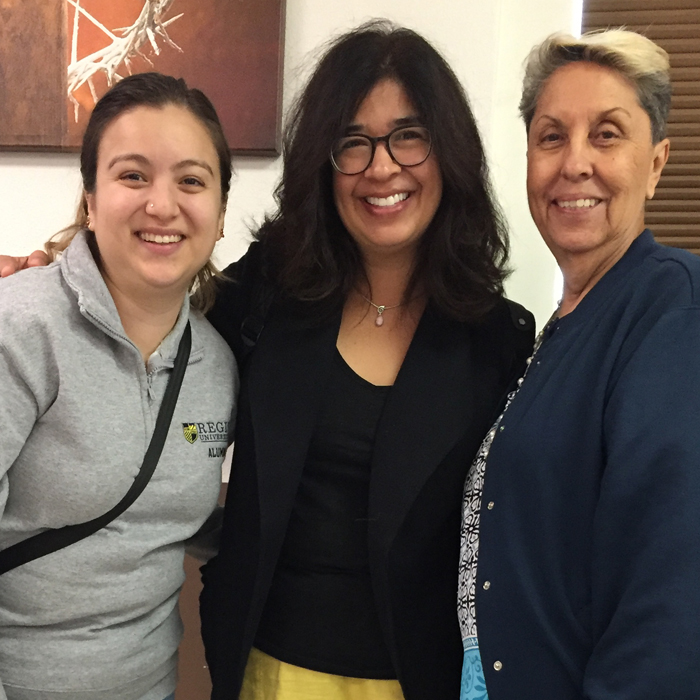
and Martha Del Real share a laugh.


Frank Okoren and his 98-year-old father, Rudy. Rudy entertained his granddaughter Karina by reciting escapades from his childhood.

It wasn't all hymns and history. There were tales of church founders arrested for bootlegging. Rudy Okoren recalled the Mass being said in Latin, with a sermon in Slovenian and a sermon in English. He smiled when confessing to skipping the second homily to steal a smoke. There were memories of altar servers, choirs, the terror of receiving your report card and a Christmas pageant with the Baby Jesus going airborne. We had such a great time, we'll do it again Saturday, March 25th, 2023.

View those entertaining stories on our YouTube Channel


https://youtu.be/GAMeDnK2kZc


Wednesday, August 4, 2021

“Holy Rosary Homecoming”

There won't be a football game, cheerleaders, a band, floats or royalty. There will be coffee, donuts, pastry and perhaps Potica. And pictures - everyone should bring pictures. (start now, looking through those scrapbooks and notebooks)
Did you attend Holy Rosary Church? Or the school? Were your parents or grandparents married at Holy Rosary? Do you remember the sisters, priests or lay teachers who taught you? Did you learn to play the piano from Sister Mary Magdalene? Are you a member of one of those families with eight or nine children who were connected to Holy Rosary? Or to those large numbers of cousins who called the parish home? Are you a current parishioner? Did your children attend religious education at Holy Rosary? Did you enjoy the many pancake breakfasts and the stories?


Picnic about 1934 Holy Rosary Choir

Right now, the plan is to hold some social get togethers several times a year in the school cafeteria - sometime during Lent would be good since no weddings or quinceañeras take place then. And bring your scrapbooks, notebooks, photos, and jokes. Bring your cousins, too. You might find out some family history!

Information will be forthcoming on the parish website 
http://holyrosarydenver.com

and our facebook page
https://www.facebook.com/HolyRosaryChurchDenver


Friday, November 6, 2020

Centennial Celebration of Holy Rosary Church

For the last several years, Holy Rosary Church has been planning a celebration of its 100 years in Globeville. There would be choirs singing in English, Spanish and Slovenian, a procession of the bible study, prayer, nocturnal adoration groups and Cursillos. Flowers would grace both the main and side altars. Afterward, there would be a reception with the ethnic foods of all the nationalities that call Holy Rosary home. We imagined Joe Sadar playing Slovenian and Croatian tunes on the accordion, and entertainment from the ballet folklorico mexico alegre. Photos, artifacts, and documents would describe the continuing story of the parish.

All our plans came to a halt in March 2020 with the arrival of the world wide epidemic. The virus threatened the flesh and bones of our parish as much as it did any human body. Many parishioners lost their jobs and contributions to Holy Rosary dropped. Just when it was needed most, the consolation of the group prayer and companionship was halted. Gradually some bright spots appeared.

At great sacrifice, Ana Galván de Tiscareño, livestreamed our Masses each day. Links to the Archdiocese on-line giving platform provided a financial life line. Parishioners reached out to each other through phone calls, cards and ZOOM meetings. The virus subsided enough for Archbishop Aquila to schedule our celebration on October 25, at 10:00 am. (Continuing restrictions dictated a limited number of attendees and names were drawn from those who submitted them - 150 in all).

Hymns were sung in English, Spanish and Slovenian, and a generous benefactor saw that masses of flowers adorned the altars. The Mass was celebrated by Archbishop Aquila, Father Frank Garcia and former pastor, Father Felix Zemeño Martín. The ceremony was lovely and can be viewed on the Archdenstreaming site

As Covid returns, the parish will again have to limit attendance. Parishioners talk wistfully about next year and remember this bright spot in a very dark year. 

From the Perko family - Three Persons - One God 
 
 
Father Frank Garcia,  Archbishop Aquila,
altar servers and Father Felix Zermeño Martín

 
Flor Santizo - a beautiful resonant voice


Wednesday, September 30, 2020

The Virus, the Holy Rosary Centennial and a Lottery

As early as 2017, parishioners began planning for the Holy Rosary Centennial, hoping to recreate the excitement of the dedication ceremony that was held July 4, 2020. There would be bilingual Mass with choirs singing in Slovenian, English and Spanish, with a reception afterward. A printed history of the parish would be available as well as a pictorial display. Perhaps there would be accordion music by Joann Birsa, and entertainment by Baile Foklorico Mexico Alegre and Krakowiacy Polish Dancers. But events during this most unusual year has meant a different kind of commemoration.

The most important part of the Centennial will be the bilingual Mass, celebrated by Archbishop Aquila on Sunday, October 25th at 10:00 am. However, in compliance with Covid19 guidelines, we will be limited to 25% of our seating capacity for the Mass. The only equitable manner to resolve who gets to physically attend the Mass will be decided by lot. All others will have to watch a live stream of the Mass.

To have a chance of attending the Mass in person, you must attend Mass on either Sunday, October 4 or Sunday, October 11 and place your name and the number of persons in your family who would like to attend on a card available at the entrance to the church. These will be placed in a basket and names will be drawn and published in the October 18 bulletin. Only those whose names are published in the October 18 bulletin will be allowed to physically attend the Mass on October 25th. 
 
Centenario del Santo Rosario. El Santo Sacrificio de la Misa por el Centenario del Santo Rosario será celebrado por el Arzobispo Aquila el domingo 25 de octubre a las 10:00 am. Será una Misa bilingüe. Estaremos limitados al 25% de nuestra capacidad de asientos para la Misa. La única manera equitativa de resolver quién puede asistir físicamente a la Misa se decidirá por sorteo. Todos los demás tendrán que ver una transmisión en vivo de la misa.

Para tener la oportunidad de asistir a la misa en persona, debe asistir a la misa el domingo 4 de octubre o el domingo 11 de octubre y colocar su nombre y el número de personas de su familia que deseen asistir en una tarjeta disponible en la entrada. a la Iglesia. Estos se colocarán en una canasta y los nombres se sortearán y publicarán en el boletín del 18 de octubre. Solo aquellos cuyos nombres se publiquen en el boletín podrán asistir físicamente a la Misa el 25 de octubre.


Saturday, December 28, 2019

Letters from Slovenia


Grandson of Teja and Alphonz Princic, Luka Komic, and Mary Lou Egan


Letter from May 5th, 1948 

“Dearest Brother Andrew,

Thank God we received your letter – we were so happy.” Apparently the families lost touch during the war and my grandpa had trouble locating them. This seems to have been their first contact since before World War II.  
Grandpa's sister was named Alojiza, (Louise) and she was married to Anton Korsic. The family's home was burned by the Nazis and they moved to the nearby town of Steverjan, which had been awarded to Italy. Each day, they had to cross a checkpoint and show their visas to work in their own vineyards in Gornje Cerovo. Two of her sons were killed during World War II.
“Dreya, I’m telling you that we are now the last of this family. I had six boys and one girl, and now I have four boys and one girl. My health is not good because of the war.”  
Two subsequent letters included photos of the family and talks about each person. Alojiza promised to write and hoped that he would too. She hoped to get her children to write also. The last letter dates from 1957.
That's the end of the correspondence, but not the end of the story. 
With hard work, the independence of Slovenia, and the European Union, the family was able to open a tavern, osteria gostilna korsic, now famous for its food, wine and hospitality. On the "History" tab on their website, is the photo of
Alojiza's family, and the answer to many questions about grandpa's family.


Extended family at the osteria gostilna korsic
 

Tuesday, June 11, 2019

Preserving the home ties

They had come to escape religious persecution and mandatory service in the armies of their oppressors - Austria-Hungary, Prussia and Russia. They were treated like second-class citizens in their own country, and their language and culture suppressed. But in America, they were free to express themselves and in Globeville they took every opportunity to celebrate and preserve their heritage.
Lydia Heck remembered, “St. Paul’s Lutheran Church was at 4438 Grant and that’s where we went to German school. We went after regular school a couple times a week. It was the same as Bible School, where we would learn catechism and to read and write in German.” Pauline Rodie added, “Our German people also had their Volga Gesangbook. The songs were long and people knew them from memory.” 

Volga Gesangbook courtesy of Virginia Laber
 
In 1889, Globeville’s Poles established the Polish National Alliance (PNA). In addition to providing burial insurance, the lodge offered a place to hold events like Polish Constitution Day, and for young people to perform plays and concerts in the Polish language. In 1902, due to the fund raising and promotional efforts of the PNA, St. Joseph's Polish Catholic Church was dedicated. In 1920, the resourceful Father Jarzynski was able to purchase the Colorado and Southern Depot for use as an elementary school, ensuring the continuation of old country faith and customs.

 Children's concert, PNA Hall. Photo Courtesy of Cathy Gizeski
 
In 1920, Globeville’s Slovenes built Holy Rosary Church and, in 1927, Holy Rosary School. Several fraternal organizations, the KSKJ, the American Fraternal Union, the Slovenian Women's Union and the Western Slavonic Association, provided financial services and a place for athletic teams, dramatic groups and choirs to express their Slovenian heritage. This child’s book was published in 1917 and carries the imprimatur of Father Cyril Zupan, OSB from Pueblo. It teaches the Slovenian alphabet, and provides simple descriptions of Slovenia, fairy tales and Bible stories.

 Jezus prijatelj otrok. Jesus is a friend of the children.

Helen Kohut Capron grew up in Globeville’s Holy Transfiguration Orthodox Church. “They tried, really tried, to teach us to speak and write in Russian. We had to go to Russian school once a week after regular school. It was like Sunday school. When my grandmother Anna passed away in 1950, we no longer spoke the language and I’ve forgotten most of it.”  
These pioneers and the fraternals are gone. Their descendants have grown up away from the neighborhood and are unaware of much of their heritage. Only the churches remain.


Friday, January 18, 2019

Neighborhood Memory Project - Globeville, Elyria, Swansea

Gracious, intelligent and sharp - Bob Padboy has almost a century of memories and is a good storyteller. Padboy was born in 1924 in a coal town in New Mexico, where his Slovenian-born father, Anton, worked in the mines. His mother Mary insisted that none of her three boys would would follow their father in the coal fields and the family moved to Globeville. Padboy is the oldest Globeville resident whose reminiscences were recorded for the Globeville, Elyria and Swansea Memory Project, and still lives in the family’s home in the neighborhood. 

 Bob Padboy in 2018. Photo® Mary Lou Egan

The Padboy house was purchased in 1940. Photo® Mary Lou Egan 

Anthony Garcia is the youngest person interviewed for the Memory Project, but his roots in the neighborhood run deep.“I was born and raised in Globeville, my mother worked at the Globeville Recreation Center for years, and my grandmother was an artist.” Garcia brought his family heritage of service to the community and creating art together. He is the co-founder of the BirdSeed Collective and has been named the director of the Globeville Recreation Center at 4496 Grant Street. Garcia hopes the center will again be a source of information and activity - “to keep the community a community.”

 Anthony Garcia at work. Photo® Mary Lou Egan  

BirdSeed Collective Mural - Where Wood Meets Steel
on Washington Street,
Photo® Mary Lou Egan
To hear the stories of Globeville, Elyria and Swansea, view these priceless interviews 
Globeville, Elyria, Swansea Memory Project

Friday, April 8, 2016

Bilingual Globeville

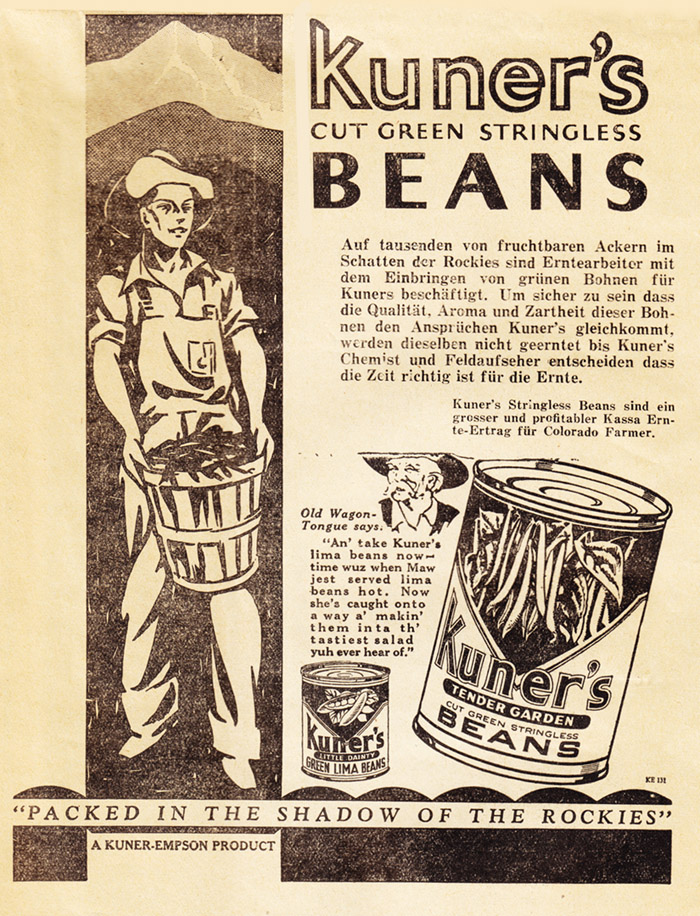
If you lived in Globeville before World War II, you would hear older people speaking in their native Polish, Slovenian, Croatian, Russian, Slovak, Czech and the distinctive German spoken by the Volga Deutsch. Many spoke a combination English and the language from the Old Country, or could speak well enough but weren't able to read and write in English. Businesses and ethnic newspapers recognized the situation and responded with graphics, and dual-language copy. Here are a few samples of local advertising that appeal to the consumer in his own language.


Got the message - butter top and cakes.


Before Colorado went dry in 1916, Martinitz and Sons had a saloon at 3455 Blake Street.
Perhaps the remedy offers an alcohol content and buzz that takes your mind off your ailments.


Combination German and English "Customer Parking Building"


1930 ad for Tuner's Cut Green Beans


Tuesday, June 16, 2015

Father Joseph Albert Meznar

"Dear family in Christ" the bulletin would begin. The following pages, sometimes as many as four two-sided sheets, would continue with the scripture readings for each day, Mass intentions, prayers for the sick (and those who cared for them), comments on Sunday's readings, and parish activities as diverse as bingo nights, the fall festival, parish breakfasts, bake, craft and rummage sales. Although the grade school had been closed in 1969, the building was used for religious education classes, receptions for First Communion and funerals and meetings of the ladies society, men's club and Knights of Columbus.
Father Meznar was particularly proud of his Slovenian heritage and was thrilled when Rich Eurich and the Preseren Glee Club from Pueblo would celebrate a Polka Mass during the month of October (to coincide with the Feast of the Holy Rosary on October 7th), followed by a breakfast of Klobase and Potica. Another expression of Slovenian culture was the Easter procession around the block, parishioners singing Zvelichar (Savior), with a strong man carrying the statue of the Risen Christ.   
Father Joseph Albert Meznar: was born in Denver on July 11, 1932. His father Joseph P. Meznar emigrated from Slovenia (then part of Austria-Hungary), worked as a bookkeeper at ASARCO's Globe Smelter and died in 1951. His mother Mary Rose Berce was born of Slovenian parents in Golden, and was a homemaker until 1951, going to work at the Denver Dry Goods for 29 years. She passed away in 1996.  Joseph Sr., and Mary Rose were married at Holy Rosary Church on May 7, 1928. Father Joseph and his brother Father Robert P. Meznar were both baptized and confirmed at Holy Rosary Church and graduated from Annunciation High School and St. Thomas Seminary. Father Joseph was ordained in 1958, Father Robert in 1960. Father Joseph served at Holy Rosary from 1982 until 2009,  overseeing a complete restoration and painting of the church in 1995, funded by the Western Slavonic Association and obtaining state historic designation for the church, convent and school in 1999 (5DV.349).  After struggling with many health issues, Father Joseph retired in November 2009 and passed away June 6, 2015.


Rich Eurich entertaining the crowd in 2006


Wednesday, April 24, 2013

Holy Rosary Parish

Among the Eastern European immigrants seeking religious liberty, economic opportunity and freedom from serving in the Austrian army were Slovenes and Croatians, who began arriving in Globeville during the 1880s. They had been farmers in the old country, but with little education, few urban skills and no knowledge of the English language, they were relegated to industrial jobs in mills and smelters. Their one avenue for spiritual and cultural expression, as well as a connection to the Old Country, was their Catholic faith, and it was their hope to build a church of their own. 
Slovenes and Croatians in Colorado had already established ethnic parishes - St. Mary's in Pueblo in 1894 and St. Joseph's in Leadville in 1899 - but it would be a longer process for those in Globeville.
Denver's Bishop Nicholas Matz urged all of Globeville's Catholics to attend St. Joseph's Polish Catholic Church and discouraged the establishment of another ethnic parish just a block away. But St. Joseph's was very small, the Polish pastor Father Jarzynski didn't speak Slovenian or Croatian and made no arrangements to bring in a priest who could. Periodically, Slavic priests from Pueblo, such as Reverend Ignatius Burgar or Father Cyril Zupan, would travel two hours by train to say Mass, hear confessions and conduct funerals at St. Jacob’s Tavern. With such sporadic attention to their spiritual needs, many people just quit attending Mass. 
Leaders in the community decided to take matters into their own hands, and on October 20, 1916, held a meeting in St. Jacob's Tavern with leaders from several fraternal lodges, dramatic societies and glee clubs. A decision was made to begin raising money in the neighborhood, appeal for funds from lodges in Leadville, Aspen, Salida and Pueblo and wait. With the death of Bishop Matz in August, 1917, a committee approached his successor Bishop J. Henry Tihen for permission to start a parish for Slovenians and Croatians. Years of planning and saving allowed the parish to move quickly after receiving the Bishop's blessing, with the ground breaking ceremony on May 27, 1919, and the completion of the building on February 20, 1920. The church was dedicated on July 4, 1920 with Bishop Tihen praising the parishioners for their efforts - reminding them that poor people, rather than princes, built the great churches of Europe.
Holy Rosary now serves the descendants of the Slovenian and Croatian founders, the Hispanic community of Globeville and new urban pioneers settling the neighborhood.

Laying the cornerstone, 1919 photo ® Mary Lou Egan

Dedication, July 4, 1920. Photo ® Mary Lou Egan

Holy Rosary Church, 2012. Photo ® Mary Lou Egan

Holy Rosary Parish

The youngest of the three churches receiving historic designation in Globeville, 
Holy Rosary Church, convent and school State Register 3/10/1999, 5DV.349

Friday, February 22, 2013

Lent

Today's Christian congregations might be urged to prepare for Easter by simplifying their lives, giving up FaceBook, Starbucks, a favorite food, television program, movies or beer. Early settlers in Globeville didn't have many luxuries to give up but regarded Lent as an opportunity for spiritual growth with greater prayer, repentance and charity. Lent was also a way to express their faith, which had been suppressed in the Old Country, and to preserve the food, traditions and culture they had left behind. 
On the day before Ash Wednesday, or Fastenacht, a German-Russian cook would serve her family schlitzkuchla, a deep-fried pastry. While the German-Russians didn't observe a strict fast, many families served meatless meals, such as Kaseknepfla,(cheese buttons) during the season. Lent was a time of frequent church attendance, with special services every Wednesday evening, and no dancing, card playing, amusements or weddings. 
Lent began for Catholics from St. Joseph's Polish and Holy Rosary Churches on Ash Wednesday with the application of ashes on the forehead, and a reminder that "dust you are and to dust you shall return". Lenten practices included abstaining from meat on Fridays and observing a fast that required the evening meal to be no larger than the combination of breakfast and lunch, and avoiding eating between meals. (It was understood that the faithful would cut back on beer and wine during the solemn season). Fridays were for the devotion known as the Stations of the Cross, Via Crucis, or Via Dolorosa, recalling the route Jesus took on his way to Golgotha, with incense, candles and Latin hymns like Stabat Mater, Mary is Standing.
Because Russian and Serbian Orthodox observed the Julian calendar, "Great Lent" usually began later than that of Roman Catholics with fasting that included not only abstaining from meat, but also certain kinds of fish and dairy. Inside the church, the royal gates to the altar remained closed to signify man's separation from God through sin, and the priest donned vestments in the somber color of purple. The Vesper service which began the lenten season was called Vespers of Forgiveness where the faithful asked forgiveness and forgave each other.
Many of the descendants of Globeville's earlier residents return to the neighborhood parishes to continue the lenten practices they practiced as children, and use the dark, cold days of Lent to prepare for the joyful resurrection of Easter. 


One of the stained-glass windows at Holy Rosary Church

German Russian Lent
St Joseph's Polish Catholic Church 
Holy Rosary Church
Holy Transfiguration of Christ Cathedral

Monday, August 16, 2010

Tradition Continues at Holy Rosary


In the photo of the first Holy Rosary Parish bazaar in 1919, the men are wearing suits and the ladies are in their native Slovenian and Croatian dresses from the “old country.” They are hoping to raise money for their new church and one can imagine that there was singing, dancing, ethnic food and games.
Holy Rosary will continue this tradition on Sunday, August 29th from 8:30 am to 8 pm in the school parking lot. There will be music, dancing and ethnic food favorites from pancakes to potica and tamales. Music and entertainment will begin at 11:30 with Matachin dancers, live bands, a DJ and Slovenian accordion master, Joann Birsa. Activities for the children include face painting and pony rides. Historic Holy Rosary Church will be open for tours at 1 pm after all the Masses.
Holy Rosary Parish is located at 4688 Pearl Street in Denver, off of I-70 and Washington Street in the Globeville neighborhood. For more information call 303-297-1962 between 9 am and 1 pm.
1919 bazaar photo courtesy of Holy Rosary Church
photos of pony rides and potica by Mary Lou Egan