Showing posts with label immigrants. Show all posts

Thursday, May 6, 2021

Ku Klux Klan and Globeville

The first Ku Klux Klan was founded in 1866 in Pulaski, Tennessee by former Confederate Army veterans with the goal of preventing African Americans from using their rights as citizens and voters. Acts of violence, lynchings and the passage of Jim Crow laws also disenfranchised blacks. This original version of the Klan was most active in the South.

Inspired by the film, “the Birth of a Nation,” William Joseph Simmons of Georgia called for the resurrection of the Klan in 1915. This new organization was more inclusive in its hatred than its predecessor, targeting not only blacks, but also Catholics, Jews, immigrants, minorities and organized labor. 

In predominantly Protestant Colorado, the Klan developed a new recruiting message that focused on the “nation’s Protestant ideals” and Americanism. Against the backdrop of prohibition, bootlegging, rampant crime, loose morals, and “free love,” the Klan also stood for law and order and a restoration of “Old-Time Religion.”

Catholics were denounced as followers of the Pope, who controlled a secret Catholic government. There were conspiracy theories about Jews, money and power. Eastern European and Russian immigrants were portrayed as dangerous, possibly anarchists, and unlikely to become loyal citizens. 

The Klan organized community events, including picnics, concerts and auto races, in order to be seen as similar to benevolent groups like the Elks Lodges. 

Globeville’s population included two of the Klan’s targets: immigrants and Catholics. The resurgence of the Klan occurred at the same time as the “Red Scare” following the Bolshevik Revolution in Russia. 

While no fiery crosses were seen in Globeville, the community was aware of the power of the organization. Leopold Korsick and his fellow workers at the Globe Smelter were advised to walk in a group to and from their shift. Many people “Americanized” their names (Starsinovich became Star), and prominently displayed American flags on their porches, or in the windows of their businesses.

Globeville survived this version of the Ku Klux Klan, but the group has resurfaced several times and portrays itself as defending American ideals.


Leopold and Teresa Korsic in Globeville


Tuesday, July 3, 2018

Immigrants and American Flags

How many American flags are in each of these photos? They seem almost as prominent as the people in the photos and they are just as significant. 
The first photo was taken of the ten-year-old Western Slavonic Association, a fraternal insurance organization that provided sick and death benefits for its members. The delegates to this convention in Leadville in 1919 are proud that their society survived and had been growing for a decade. In addition, members of the Western Slavonic wanted to make a strong statement about their loyalty to their new country.
After World War I, Americans sought to distance themselves from the rest of the world and turned inward. The Great War had cost American lives, but had failed to make the world safe for Democracy. The violence and anarchy of the Bolshevik Revolution was the last straw.
While the United States had welcomed and even recruited immigrants from the 1880s to World War I, it seemed time to be much more selective, and Globeville's immigrants received increased scrutiny.
Who were these people anyway? Slovenes? Croats? Their passports said Austria. And German Russians - were they German or Russian? Carpatho-Russians? Are they Bolsheviks?
These groups had large families, were Papists (Catholic) or Orthodox, clannish, and came from regions of the world rife with revolutions and assassinations. They might be anarchists! And they didn't speak English.
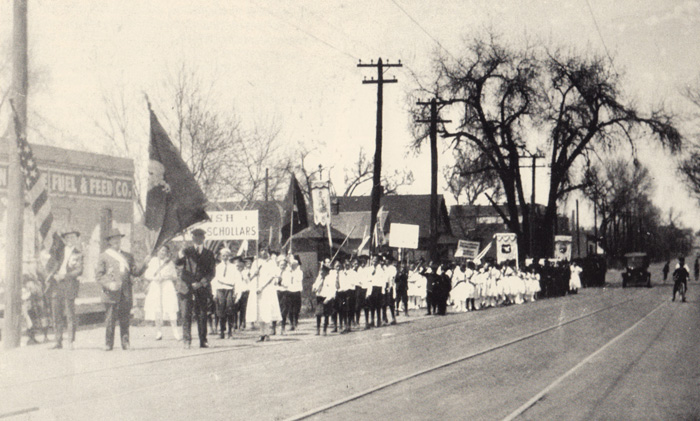
Even though many of their sons had served in the U. S. military during World War I, ethnic groups in Globeville were suspect. Aware of the distrust leveled at them, people prominently displayed American flags at church and lodge gatherings. A strong statement to emphasize their loyalty. 


 1919 convention of the Western Slavonic Association

Gathering of Serboban Lodge

Polish National Alliance, May Day parade on Washington Street

Wednesday, November 23, 2016

Tiny Houses - Shotgun Houses in Globeville

The tiny houses built in Globeville before the 1900s were not an architectural statement or expression of a social movement, but a source of intense pride for the immigrants who arrived during the 1890s. In the old country, successive division of farms through inheritance meant that many farms were too small to sustain a family. Many newcomers from eastern Europe and Russia had been farmers in their homeland, but worked for low wages in Globeville's smelters, railroads and meatpacking plants. They built what they could afford on lots that varied from 37 feet wide to 150 feet long, to 25 feet wide and 175 feet long. Their houses were monuments to their sacrifices, thrift and pride.
Many houses were built in the "shotgun" style - long and narrow, single story homes with sequential rooms and no hallway. As the family grew or more relatives arrived from the old country, rooms could easily be added. A front porch that extended the full width of the front of the house offered a place to sit and visit with neighbors.
Railroad cars could be purchased from the nearby Burlington shops and friends helped each other dismantle the cars and construct houses, barns, and outbuildings from the tongue-in-groove lumber. Most houses and outbuildings were well maintained, with tidy gardens and well-kept yards. Some women even scrubbed their porches and sidewalks. A characteristic of Globeville remains the number of one-story frame houses built close together on long, narrow lots. 

 4531 Pearl Street was built in 1891
North side of 4485 Pennsylvania Street shows the length
House was built in 1908


Thursday, September 29, 2016

Red Scare 1920s

They were misunderstood from the beginning. The newcomers had large families, were Catholic or Orthodox, had come from regions in eastern Europe and Russia that were riddled with anarchists, and didn't speak English. Were the Volga Deutsche German? Or Russian? Why was Holy Transfiguration Church topped with a gold onion dome? Who are the Carpatho-Rusyns? 


Immigrants in Globeville had been recruited by smelters, railroads and the beet industry during the economic boom of the 1880s to supply cheap, abundant labor. After the economic downturn in 1893, they were not welcome and retreated to their enclaves, worshiping in old-world churches, socializing with people from the same region of Europe, and congregating in their ethnic saloons, which increased suspicion and misunderstanding.

The devastation of World War I and Spanish Influenza caused Americans and Coloradans to pull back from foreign entanglements. The war had not made the world "safe for democracy" - Europe was still in turmoil - and the Bolshevik's revolt in Russia resulted in civil war, famine and Communist rule. Anything and anyone associated with Bolsheviks, anarchists, foreign agitators, or radical labor unions were considered dangerous.

In the mind of the public, unions were linked with violence, anarchy and Communism. People remembered that smelter workers in Globeville, members of the Mill and Smeltermen, (a subsidiary of the Western Federation of Miners) had participated in the violent strikes in 1903. Labor unrest after World War I, supposedly incited by Bolsheviks spurred the Colorado legislature to pass a law in 1919 forbidding the display of the “red flag” in public. The headquarters of the International Workers of the World in Pueblo were raided and suspected radicals rounded up; and in Denver an ordinance was passed forbidding any person from speaking in a manner that could incite “rebellion.” The most dramatic example of the “red scare” occurred in the summer of 1920, when unionized employees of the Denver Tramway Company went on strike to protest wage cuts. When the company imported strikebreakers, violence erupted, cars were overturned and burned in downtown Denver. In the public's opinion, unions were violent and dangerous.
 
Residents of Globeville took notice of public opinion. Fraternal organizations displayed large American flags during their gatherings, and many business hung American flags in their windows. Some people left Transfiguration Russian Orthodox Church, while others

“Americanized” their names - Staresinich was shortened to “Star,” Snidersich changed to “Snyder,” Yakin became “Jackson.” 

Gradually the “red scare” subsided, but the negative attitudes toward immigrants remained. Bowing to the growing fear that people from eastern Europe threatened the nation's very existence, Congress passed a law in 1924* that effectively ended immigration from eastern Europe.

* The Johnson-Reed Immigration Act of 1924 limited the number of immigrants allowed into the United States through a national origins quota. The quota provided immigration visas to two percent of the total number of people of each nationality in the United States as of the 1890 national census. It completely excluded immigrants from Asia. 


1921 Convention WSA, Pueblo
Photo used with written permission from Joseph Skrabec

Sjedinjenih "One for All" Orthodox Lodge
used with written permission from Steve Machuga

Polish Constitution Day Parade, 1940
used with written permission from Jan Gisewski Garland

Friday, February 19, 2016

Polish National Alliance, St. Martin's 134


The storefront behind the Polish scout troop seems much larger in the 1935 photo than it does now. Today, the structure at 4839 Washington is encased in stucco and devoid of any defining features, but was once home to St. Martin's Society, Group 134 of the Polish National Alliance and the gathering place for Globeville's Polish community for over a century. Globeville's lodge, founded on October 5, 1889, was a branch of the national society headquartered in Chicago. The organization offered sick and death benefits, financial services, fellowship for Polish immigrants, as well as enlightenment about their rights and obligations as American citizens.
In addition to providing a financial safety net for families, PNA was committed to preserving Polish heritage by celebrating Polish Constitution Day on May 3rd, Corpus Christi during June, and the special foods and culture of their partitioned homeland. There were activities for every age group and demographic: the Polish Falcon Nest 712, a group practicing physical fitness and para-military training; the St. Adalbert's Society, a coed society for young adults; the Polish Falcons baseball team; and the Polish Harmony Club, for young adults who enjoyed singing and dancing. Globeville's Poles maintained connections to other Polish communities in larger cities like Chicago, and the towns of Pueblo, Trinidad, Walsenburg, Starkville and Rockdale in Colorado through the PNA newspaper, Zgoda,(Harmony). The lodge was instrumental in the establishment of St. Joseph's Polish Catholic Church in 1902, and its parochial school in 1926. 
With the coming of New Deal programs like Social Security, improvements in workplace safety and other avenues for health insurance, fraternal lodges lost much of their importance. American-born children were less committed to preserving their Polish heritage, and had many other opportunities for social activities than those offered by PNA. After World War II, the descendants of the Polish pioneers had moved to new homes in the suburbs and visited Globeville and St. Joseph's Church only for holidays or funerals. After the breaking up of the Soviet Union, new arrivals from Poland attend St. Joseph's Church, but celebrate their heritage at the Polish Club of Denver.
Although the Polish National Alliance no longer has an active organization, the society left its imprint on the Globeville neighborhood in St. Joseph's parish. 


Friday, December 6, 2013

Frederick F. Dometrovich, Theodore Dorak, Lawrence Goreski

There is a stained glass window above the altar in Holy Rosary Church that was donated in 1920 by the Dometrovich family, immigrants from Croatia. How proud they were to have son Frederick complete school at North High, then graduate from the University of Colorado School of Medicine. At age 34, married, and the father of two children, Dometrovich would have been exempt from the draft, but enlisted in the Army Medical Corps in August, 1942. Dometrovich served as a physician in the South Pacific, including Oro Bay, New Guinea and Gilbert Islands and died as the result of typhus contracted in the line of duty. Survived by his wife, children Margo and Fred, Jr., mother Mrs. Anna Dometrovich, brothers Frank and John, and sister Mrs. Mary Hamilton, Dometrovich received the American Theater Medal, and the Asiatic Pacific Medal and Citation.


Theodore Kenneth Dorak was one of many young men who enlisted in the Navy December 8, 1941, the day after the Japanese attack on Pearl Harbor. After training at San Diego, California, Dorak was assigned to the Naval Air Force aboard the USS Yorktown. A later assignment took Dorak to the aircraft carrier USS Franklin, where he participated in air raids over Marcus, Wake, Kwajalein, Truk, Saipan, Palau, Hollandia, and the Japanese mainland. Killed in action March, 1945, during a battle off the Japanese coast, Dorak was remembered with a plaque on the east side of St. Michael's Chapel at Riverside Cemetery. Dorak was survived by his parents, Mr. and Mrs. E. E. Dorak, brothers Edward J. Jr. and Daniel Dorak, and sister Mary Ellen Dorak. Dorak was awarded the Purple Heart, Asiatic Pacific Medal, Presidential Unit Citation, and the American Theater, Good Conduct and World War II Victory Medals.


Lawrence Goreski was 27 years old, married to Margaret and had a young daughter, Laura Jean when he enlisted in the Army Air Force January 11, 1942, a month after Pearl Harbor. Goreski entered flight training at Ellington Field, Houston, Texas, and received his commission as 2nd Lieutenant at Victorville, California. Assigned to combat flight duties in England October 28, 1942, Goreski was reported Missing in Action December 30, 1942, while participating in a bombing mission of a submarine base in Lorient, France. Besides his wife and children, Goreski was survived by his parents, Mr. and Mrs. Pete Goreski, and a brother, Paul Goreski. Goreski received the Purple Heart, European Theater, American Theater and World War II Victory Medals. 


Wednesday, April 24, 2013

Holy Rosary Parish

Among the Eastern European immigrants seeking religious liberty, economic opportunity and freedom from serving in the Austrian army were Slovenes and Croatians, who began arriving in Globeville during the 1880s. They had been farmers in the old country, but with little education, few urban skills and no knowledge of the English language, they were relegated to industrial jobs in mills and smelters. Their one avenue for spiritual and cultural expression, as well as a connection to the Old Country, was their Catholic faith, and it was their hope to build a church of their own. 
Slovenes and Croatians in Colorado had already established ethnic parishes - St. Mary's in Pueblo in 1894 and St. Joseph's in Leadville in 1899 - but it would be a longer process for those in Globeville.
Denver's Bishop Nicholas Matz urged all of Globeville's Catholics to attend St. Joseph's Polish Catholic Church and discouraged the establishment of another ethnic parish just a block away. But St. Joseph's was very small, the Polish pastor Father Jarzynski didn't speak Slovenian or Croatian and made no arrangements to bring in a priest who could. Periodically, Slavic priests from Pueblo, such as Reverend Ignatius Burgar or Father Cyril Zupan, would travel two hours by train to say Mass, hear confessions and conduct funerals at St. Jacob’s Tavern. With such sporadic attention to their spiritual needs, many people just quit attending Mass. 
Leaders in the community decided to take matters into their own hands, and on October 20, 1916, held a meeting in St. Jacob's Tavern with leaders from several fraternal lodges, dramatic societies and glee clubs. A decision was made to begin raising money in the neighborhood, appeal for funds from lodges in Leadville, Aspen, Salida and Pueblo and wait. With the death of Bishop Matz in August, 1917, a committee approached his successor Bishop J. Henry Tihen for permission to start a parish for Slovenians and Croatians. Years of planning and saving allowed the parish to move quickly after receiving the Bishop's blessing, with the ground breaking ceremony on May 27, 1919, and the completion of the building on February 20, 1920. The church was dedicated on July 4, 1920 with Bishop Tihen praising the parishioners for their efforts - reminding them that poor people, rather than princes, built the great churches of Europe.
Holy Rosary now serves the descendants of the Slovenian and Croatian founders, the Hispanic community of Globeville and new urban pioneers settling the neighborhood.

Laying the cornerstone, 1919 photo ® Mary Lou Egan

Dedication, July 4, 1920. Photo ® Mary Lou Egan

Holy Rosary Church, 2012. Photo ® Mary Lou Egan

Holy Rosary Parish

The youngest of the three churches receiving historic designation in Globeville, 
Holy Rosary Church, convent and school State Register 3/10/1999, 5DV.349

Sunday, January 20, 2013

Woman's Glory, The Kitchen

The title was "Woman's Glory, The Kitchen," (which says volumes about women's aspirations in a certain era) but there was also "Kuche Kochen," and "Treasured Polish Recipes for Americans," titles of cookbooks published mid 20th century to instruct "modern homemakers" how to prepare the ethnic dishes their mothers had made. And there were compilations of recipes published by church groups, ladies societies and fraternal organizations in an effort to preserve an ethnic culture that was vanishing as immigrants assimilated. 
But these old books offer much more than kitchen tips and recipes. Inside Woman's Glory, one would find several recipes for potica, a description of the region in which that version originated, information about the person submitting the recipe and lodge events. The German-Russian cookbook, Kuche Kochen, has an entire chapter devoted to blini, along with instructions for preserving food for the winter, customs in the author's village in Russia and prayers said before and after meals.  Published in the 1940s, "Treasured Polish Recipes for Americans"  contained insights into Polish culture as well as instructions for cooking Polish favorites. There are many vintage ethnic cookbooks, but the best ones offer a glimpse into the immigrant culture and way of life even as it was disappearing.  


Published by the Slovenian Women's Union of America


Available from the Polish Art Center


Wednesday, January 16, 2013

Citizenship

Immigrants who settled in Globeville from the 1880s to the 1920s were mostly farmers from Eastern Europe and Russia with little education, few urban skills and no knowledge of the English language. Working in the smelters, railroads and meat packing plants made newcomers realize that better jobs and a better life came to those who could speak English and were American citizens. 
To become an American citizen a person had to be of "good moral character, have the ability to read, write, speak, and understand English, and have knowledge of the fundamentals of U.S. history and government," (also required today).
The first step was the easiest since the immigrant's sponsor (perhaps Maximilian Malich or John Wolf) would vouch for his "good moral character." But how could anyone learn to read and write English while working 12 hour days, six days a week? Schools, lodges and some churches came to the rescue. Principal Matthew Eagleton instituted night classes in English at Garden Place School, the "Slavonian" Lodge, St. Jacob's Croatian Society also held English-language lessons for members, and (after 1916) Denver's Opportunity School. As children learned English in school, they taught their parents, and, by the 1920s, there were radio programs, movies at Globeville's Cozy Theatre and baseball. Once the language was mastered, the study of U.S. history and government could be tackled with the aid of pamphlets containing the questions likely to be asked, such as ""Name the original 13 colonies, How can the president prevent a bill from becoming a law? What is the term of office of a U.S. Representative?" (The Questionnaire shown below was prepared for a Volga-German congregation in Nebraska during the 1900s).
Today's immigrants face the same challenges: a new language, different culture, unfamiliar customs, separation from family and little time to learn English and the fundamentals of U.S. history. There are classes nearby at El Centro San Juan Diego, Trevista Elementary School, Emily Griffith Opportunity School and Holy Rosary Parish Center.
Clases de Ingles: Las Clases de Inglés reinician el día lunes 14 de enero de 10:00 a.m a 12:00 p.m. en el Centro Parroquial. ¡Te esperamos!
Holy Rosary Church
Emily Griffith Opportunity School


Used with written permission from John Werner


English learner at Holy Rosary Parish Center


ESL class at Holy Rosary 


Sunday, July 29, 2012

Women's Work

The women in the photo appear pleasant although few are smiling. Surely they welcomed a short break from the heat and noise inside the building to pose for the photographer. Their employer, the New Colorado Laundry at 2207 Larimer Street, was the kind of business that hired women in the early 1900’s, since they could be paid little money and required minimal training. Many ladies from Globeville worked at one of the commercial laundries in downtown Denver, such as Silver State at 2441 Broadway, Ideal at 2500 Curtis Street and Enterprise Laundry at 17th and Champa, all within a couple of miles from Globeville.
These women weren't pursuing satisfying careers but supplementing the family's income with the kind of jobs available to them. Steve Machuga remembered, "My mother worked outside the home when I was growing up, scrubbing floors and cleaning rooms at the Brown Palace Hotel for 50¢ a night. She walked with two other ladies from Globeville, up 38th Street to short Larimer and 20 blocks to the hotel. The street car cost 10¢ each way, so they walked."  
Many other Globeville ladies worked as "domestics" doing cooking, cleaning and laundry in the homes of Denver's wealthier citizens. There were also situations available in the many local family-owned taverns, with the bar in the front of the building, living quarters for the family in the rear, and rooms upstairs for the men employed in the smelters. Newcomers like Jennie Hocevar could prepare meals for the family, pack lunches for the boarders and begin the process of learning English and American ways. Jennie later worked at Cudahy, trimming the fat from meat as it came down the chute. “I trimmed more than anybody else and I couldn’t even speak English,” she remembered.
Most women in the 1900s regarded work was a necessity and appreciated the kind of job that would help their family live a better life.

Photo used with written permission from Agnes Tanko. Her mother, Mary Holland, is one of 
the young women in the photo.

Jennie Hocevar Sadar, photo used with written permission from Dorothy Nevelos

Thursday, May 10, 2012

John and Katherine Peketz

The story of John and Katherine Peketz is one of opportunity and upward mobility in America. An immigrant from Slovenia, John Peketz is listed as a laborer in the 1905 edition of the Denver city directory, but by 1911 he is recorded as working as a bartender at John Predovich's saloon. In 1915, Peketz opens his own tavern at 4511 Washington Street.
Before Prohibition (Colorado went dry in 1916, four years before the rest of the nation) immigrant saloons operated as banks, social clubs and clearinghouses for newcomers where a recent arrival could get a drink, a good meal, news from the Old Country, a place to stay, a loan, and advice concerning jobs and meeting other young and single people from home. Tavern owners like Peketz knew everyone and everything happening in Globeville.
By Globeville's standards Peketz was prosperous, owning his own home and operating a successful business, but he never forgot his humble beginnings. Peketz helped found the Western Slavonic Association (WSA), a fraternal organization that provided financial help to families in case of sickness or injury. Katherine Peketz then formed a women's branch of the association, Holy Rosary Lodge, Number 7, which focused on service to the community. Using their business and fraternal connections, the couple then worked to raise money to build Holy Rosary Church in 1919. Their lives and contributions can be remembered in two windows in the church that feature St. Catherine and St. John the Baptist.
Top photo: John and Katherine Peketz in their grocery store. After Colorado went dry in 1916, many former taverns became grocery stores. Photo used with written permission from Don Snider
Second photo: 4511 Washington, site of the Peketz Saloon
Third photo: Location of Western Slavonic Hall, today the McDonald's on Washington Street. Photo used with written permission from Joe Sadar
Bottom photo: Peketz windows in Holy Rosary Church.


Western Slavonic Association
Holy Rosary Church


Wednesday, September 9, 2009

Beautiful Globeville


The Globeville tradition of lovely gardens and yards continues in many places. The area is challenged by noise and pollution from the Interstate highways and encroaching industry, yet there is still a sense of pride in the neighborhood. Take a walk some morning and look at the flowers in the front yards, peer over the fences and see the vegetable extravaganza in the back yards. Some folks could feed an army with the produce grown in these small spaces. Here are a few of my favorites on the north side of I-70.