Showing posts with label Hispanic. Show all posts

Monday, November 28, 2022

Stories from Holy Rosary Homecoming

Any parish that's been around for more than a century has stories to tell and the folks who attended the Homecoming event at Holy Rosary on October told them in abundance.

We began with Mass, of course. Joann Birsa sang "Kraljica venca rožnega" in Slovenian and the congregation followed with the same hymn "O Queen of the Holy Rosary" in English. In his homily, Father Frank Garcia paid tribute to the faith and perseverance of the Slovenian and Croatian founders, the teachers and pastors and the current Spanish parishioners who sustain the parish. The Mass concluded with the singing of "Tantum Ergo" and "Holy God We Praise Thy Name." We then retired to the school cafeteria for coffee, Potica, sandwiches and sharing photos and memories.


Joann Birsa has documented Slovenian songs and hymns. 


Their Croatian heritage is important to the Kalcevic family,
who has been farming in Colorado since 1898. 
Jeff Kalcevic, Mac, Bronwyn and Bo
https://kalcevicfarmsinc.business.site


Jim Peketz' family were among those who established Holy Rosary,
 as well as the Western Slavonic Association.
The family sponsored two stained glass windows in the church.
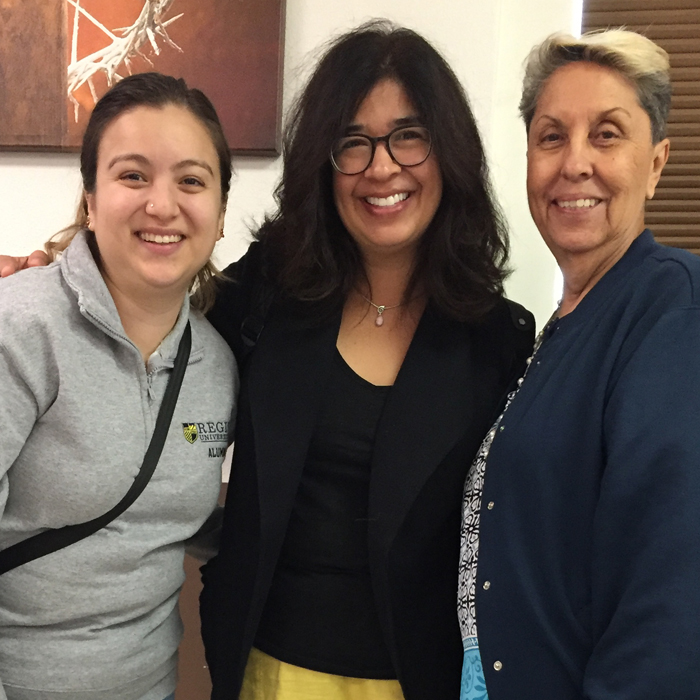

Magali Martinez, Nicki Gonzales, PhD (Vice Provost for Diversity
and Inclusion, and Professor of History at Regis University)
and Martha Del Real share a laugh.


Frank Okoren and his 98-year-old father, Rudy. Rudy entertained his granddaughter Karina by reciting escapades from his childhood.

It wasn't all hymns and history. There were tales of church founders arrested for bootlegging. Rudy Okoren recalled the Mass being said in Latin, with a sermon in Slovenian and a sermon in English. He smiled when confessing to skipping the second homily to steal a smoke. There were memories of altar servers, choirs, the terror of receiving your report card and a Christmas pageant with the Baby Jesus going airborne. We had such a great time, we'll do it again Saturday, March 25th, 2023.

View those entertaining stories on our YouTube Channel


https://youtu.be/GAMeDnK2kZc


Friday, November 6, 2020

Centennial Celebration of Holy Rosary Church

For the last several years, Holy Rosary Church has been planning a celebration of its 100 years in Globeville. There would be choirs singing in English, Spanish and Slovenian, a procession of the bible study, prayer, nocturnal adoration groups and Cursillos. Flowers would grace both the main and side altars. Afterward, there would be a reception with the ethnic foods of all the nationalities that call Holy Rosary home. We imagined Joe Sadar playing Slovenian and Croatian tunes on the accordion, and entertainment from the ballet folklorico mexico alegre. Photos, artifacts, and documents would describe the continuing story of the parish.

All our plans came to a halt in March 2020 with the arrival of the world wide epidemic. The virus threatened the flesh and bones of our parish as much as it did any human body. Many parishioners lost their jobs and contributions to Holy Rosary dropped. Just when it was needed most, the consolation of the group prayer and companionship was halted. Gradually some bright spots appeared.

At great sacrifice, Ana Galván de Tiscareño, livestreamed our Masses each day. Links to the Archdiocese on-line giving platform provided a financial life line. Parishioners reached out to each other through phone calls, cards and ZOOM meetings. The virus subsided enough for Archbishop Aquila to schedule our celebration on October 25, at 10:00 am. (Continuing restrictions dictated a limited number of attendees and names were drawn from those who submitted them - 150 in all).

Hymns were sung in English, Spanish and Slovenian, and a generous benefactor saw that masses of flowers adorned the altars. The Mass was celebrated by Archbishop Aquila, Father Frank Garcia and former pastor, Father Felix Zemeño Martín. The ceremony was lovely and can be viewed on the Archdenstreaming site

As Covid returns, the parish will again have to limit attendance. Parishioners talk wistfully about next year and remember this bright spot in a very dark year. 

From the Perko family - Three Persons - One God 
 
 
Father Frank Garcia,  Archbishop Aquila,
altar servers and Father Felix Zermeño Martín

 
Flor Santizo - a beautiful resonant voice


Tuesday, January 5, 2016

Little Christmas tradition in Globeville

Globeville's early settlers practiced Christmas traditions from the old country, providing a source of comfort and connection to familiar traditions in their new circumstances. For many, St. Nicholas Day on December 6th meant setting out shoes or hanging a stocking the night before and discovering a small treat, an orange or candy, in the morning. For the Volga Germans, Poles, Slovenes and Croats, Christmas Day was reserved for attending church, visiting family, sharing a meal, exchanging modest gifts and remembering family left behind.
For Greek Uniate and Orthodox Slavs, Christmas Day was a religious holiday, but it was the feast of the Epiphany on January 6th, and the adoration of the infant Jesus by the three kings that was celebrated in a big way. Gifts were exchanged in remembrance of the gold, frankincense and myrrh brought by the Magi, and homes were blessed in honor of the three kings' visit to the home of the Holy Family. After the house had been blessed, the names of the kings, Gaspar, Melchior and Balthasar, were written on the back of the door in chalk.
For Hispanics in Globeville, the 6th day of January, El Dia de Los Reyes, is also an important tradition. The kings pay tribute to the infant redeemer, bring small gifts to delight children and continue a custom many remember from Mexico.

The Magi visit the Holy Family at Holy Rosary
Holy Rosary Parish


Friday, February 22, 2013

Lent

Today's Christian congregations might be urged to prepare for Easter by simplifying their lives, giving up FaceBook, Starbucks, a favorite food, television program, movies or beer. Early settlers in Globeville didn't have many luxuries to give up but regarded Lent as an opportunity for spiritual growth with greater prayer, repentance and charity. Lent was also a way to express their faith, which had been suppressed in the Old Country, and to preserve the food, traditions and culture they had left behind. 
On the day before Ash Wednesday, or Fastenacht, a German-Russian cook would serve her family schlitzkuchla, a deep-fried pastry. While the German-Russians didn't observe a strict fast, many families served meatless meals, such as Kaseknepfla,(cheese buttons) during the season. Lent was a time of frequent church attendance, with special services every Wednesday evening, and no dancing, card playing, amusements or weddings. 
Lent began for Catholics from St. Joseph's Polish and Holy Rosary Churches on Ash Wednesday with the application of ashes on the forehead, and a reminder that "dust you are and to dust you shall return". Lenten practices included abstaining from meat on Fridays and observing a fast that required the evening meal to be no larger than the combination of breakfast and lunch, and avoiding eating between meals. (It was understood that the faithful would cut back on beer and wine during the solemn season). Fridays were for the devotion known as the Stations of the Cross, Via Crucis, or Via Dolorosa, recalling the route Jesus took on his way to Golgotha, with incense, candles and Latin hymns like Stabat Mater, Mary is Standing.
Because Russian and Serbian Orthodox observed the Julian calendar, "Great Lent" usually began later than that of Roman Catholics with fasting that included not only abstaining from meat, but also certain kinds of fish and dairy. Inside the church, the royal gates to the altar remained closed to signify man's separation from God through sin, and the priest donned vestments in the somber color of purple. The Vesper service which began the lenten season was called Vespers of Forgiveness where the faithful asked forgiveness and forgave each other.
Many of the descendants of Globeville's earlier residents return to the neighborhood parishes to continue the lenten practices they practiced as children, and use the dark, cold days of Lent to prepare for the joyful resurrection of Easter. 


One of the stained-glass windows at Holy Rosary Church

German Russian Lent
St Joseph's Polish Catholic Church 
Holy Rosary Church
Holy Transfiguration of Christ Cathedral

Tuesday, December 18, 2012

Christmas visitors

Globeville is rich with the traditions of the many ethnic groups who have settled there. Early settlers from the Carpathian mountains, Slovaks, celebrated with a meal that featured 12 food items to symbolize the 12 apostles. Afterward, there might be a visit from the jaslickari or Star Carolers, young men and boys dressed as the Three Kings or shepherds and an angel carrying a star on a pole. One member of the group carried a creche and told the story of the nativity in song. An extra place was always set at the Christmas table to receive a traveling stranger who might be the Christ Child in disguise.
Globeville was also home to many German-Russians from Norka, Russia who brought with them the custom of the Christkind and the Pelznickel. The role of the Christkind was usually played by a young lady with a clear voice, dressed in white with a veil over her face to hide her identity. She would arrive on Christmas Eve to question the children of the house. Did you obey your parents? Have you said your prayers faithfully? If the children answered these questions satisfactorily, they were given small gifts (provided by the parents) and the Christkind departed to visit the other homes on her route. For unruly or disobedient children, the Pelznickel was summoned. The Pelznickel was portrayed by a strong young fellow with an unkempt beard dressed in a sheepskin coat, a long chain over one shoulder and a bundle of switches in his right hand. Children would hear a recitation of their misdeeds and would hear the sound of the switches. Only after the children had promised to behave in the future did the Pelznickel disappear into the night. The threat of the Pelznickel appearing would be enough to keep many children from misbehaving all year. 
Las Posadas is a wonderful Mexican tradition where travelers recreate the story of Mary and Joseph as they search for a place to stay in Bethlehem before the birth of Jesus.  The holiday ritual includes a procession of pilgrims or peregrinos dressed as Joseph, Mary, angels, shepherds and the Three Wise Men travel from house to house until they reach the home designated as the Inn. Upon arrival, the procession is met at the door by the "innkeepers" and sing a lyric asking for shelter. Joseph and Mary are finally recognized and allowed inside where everyone rejoices with songs, prayers, music and sweets. The custom can last nine days, from December 16 to Christmas and is practiced by families and congregations in Globeville, including one on Monday, December 17 from Holy Rosary Church. 

Christmas Traditions in Norka

Holy Rosary Church


Tuesday, March 23, 2010

Zvelichar


"Zvelichar nash je vstal od smrti...Sing joyfully o Christian, because today on Easter is the day of your joy." For many years, this Slovenian hymn was sung during the procession on Easter morning at Holy Rosary Church, a parish founded by Slovenians and Croatians in 1919. Leading the procession would be a strong man carrying the statue of the Risen Christ, followed by children singing Zvelichar and carrying palms.
Today's congregation consists of older Eastern European parishioners and younger Hispanic families. This year's traditions begin with:
  • Mass of the Lord's Supper at 6:00 pm on Holy Thursday, April 1st
  • Service of the Lord's Passion at 3:00 pm on Good Friday, April 2nd
  • Easter Vigil at 7:00 pm Holy Saturday, April 3rd
  • Easter Mass at 8:00 and 10:00 am, Sunday April 4th
For more information, call 303-297-1962 between 9:00 am to 1:00 pm Monday through Friday. Holy Rosary Church is located at I-70 and Washington at 4688 Pearl Street in the Globeville neighborhood.

Thursday, January 7, 2010

Hispanics in Globeville


After World War II, the children and grandchildren of Globeville’s pioneers would move out of the neighborhood and another group would take their place.

Hispanics who moved to Globeville were not new to Colorado or to America. Lalo C. de Baca came to Globeville from a farm in Las Vegas, New Mexico in 1936, but can trace his family’s ancestry to Spanish explorer Alvar Cabeza de Vaca, who traveled through northern New Mexico in the early part of the 16th century. Bea Trevino moved to Globeville from a farm near Firestone but her family’s roots go back farther. “My ancestors from my mother’s side all came from Spain. My dad’s mother was an Indian.”
Hispanics came to Globeville for the same reasons as the ethnic groups that preceded them: affordable housing, more opportunity for their children than farm life could offer and jobs that were nearby. In the 1950s and 60s, many of those jobs were in meat packing, the city’s largest industry, at ASARCO's Globe plant and in construction.
Unlike the Eastern Europeans who had preceded them, Hispanics found many of the institutions that were important to them already in place with Catholic Mass at St. Joseph’s Polish or Holy Rosary Church. Improvements in workplace safety also made forming a fraternal insurance association less of a necessity.
Today, 82 percent of Globeville's population has Hispanic heritage and the community reflects that change with church services at the Globeville Community Church at 5039 Lincoln and a Spanish-speaking priest, Father Noé Carreón, at Holy Rosary Church.
What has remained constant in the neighborhood's 150-year history is pride and neighbors caring for one another.