Showing posts with label Volga Germans. Show all posts

Friday, April 8, 2016

Bilingual Globeville

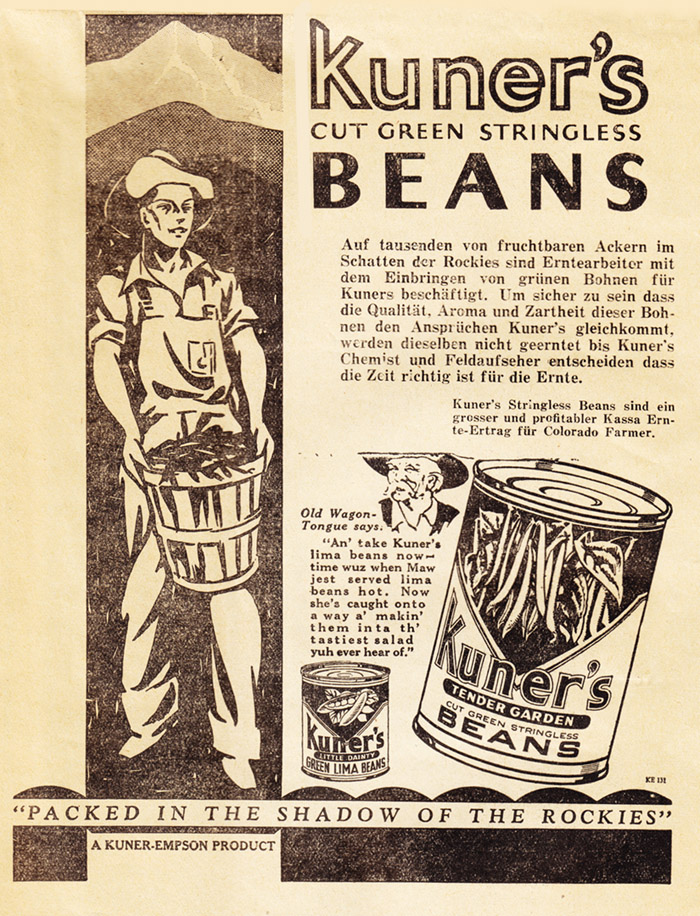
If you lived in Globeville before World War II, you would hear older people speaking in their native Polish, Slovenian, Croatian, Russian, Slovak, Czech and the distinctive German spoken by the Volga Deutsch. Many spoke a combination English and the language from the Old Country, or could speak well enough but weren't able to read and write in English. Businesses and ethnic newspapers recognized the situation and responded with graphics, and dual-language copy. Here are a few samples of local advertising that appeal to the consumer in his own language.


Got the message - butter top and cakes.


Before Colorado went dry in 1916, Martinitz and Sons had a saloon at 3455 Blake Street.
Perhaps the remedy offers an alcohol content and buzz that takes your mind off your ailments.


Combination German and English "Customer Parking Building"


1930 ad for Tuner's Cut Green Beans


Thursday, October 11, 2012

Krautburgers, Kraut Bierochs, Runzas

Nothing evokes a memory like a certain smell. The fragrance of onions, cabbage and simmering ground beef. The heavenly aroma of the thin pastry pocket that encloses the mixture. The scent wafts across the parking lot of the First Plymouth Congregational Church in South Denver, but transports me to my grandmother's kitchen in Globeville.
Although my grandmother, Ida Ose Jackson, was Swedish and my Grandfather, Andy Jackson, was Slovenian, most of their neighbors on Sherman Street were Volga Germans and this recipe, like the local gossipwas probably exchanged over the back yard fence. Grandma didn't use a printed recipe but talked throughout the cooking process (so young apprentices needed to watch and listen).  
Like a lot of German Russian fare, krautburgers are made with humble ingredients, cabbage, onion, ground beef and a simple pastry, but can be dressed up with bacon, ham, sausage, cheese and potatoes. Economical, tasty and easy-to-make, these are great directly from the oven, reheated, or cold for a picnic lunch. 
Like the Volga Germans, the recipe migrated from the Rhinelands, to Russia and then to the heartland of America, the ingredients and instructions relayed by word of mouth. As the first generation of Volga immigrants to Colorado passed on, efforts were made to preserve the history, traditions, culture and unique heritage of this little known group and the American Historical Society of Germans from Russia was founded in Greeley, Colorado in 1968. The Society would eventually move its headquarters to Lincoln, Nebraska, which had been a clearinghouse for German Russian immigrants. Today, the organization hosts multiple chapters in 24 states and Canada with collections of photos, publications, resources for genealogy and educational programs.
Members of the Metro Denver chapter held their twice yearly bake sale October 6th at the First Plymouth Congregational Church. The funds collected help support the organization's meetings and events, including the next opportunity for ready-made kraut burgers in April. 


Members of the Metro Denver Chapter preparing the filling


American Society of Germans from Russia

North Dakota State University, Germans from Russia Collection

Monday, August 20, 2012

Working the beets


“No Race Suicide in Globeville Where Beetworkers Live on Summer Wages” proclaims the Denver Republican from December 8, 1911. The story begins, “Globeville, the suburb of Denver ... has just half the number of inhabitants in the summer that it has in winter. Its Poles, Russians, Slavs ...went forth in early spring to work in the sugar beet fields and earn their keep for the winter.” The Republican continues enthusiastically, “The Fijalkowskis spent the summer working in the beet fields at Monte Vista. They consider their farm lands regular resorts.”
Globeville resident Ann Morgan remembered it differently. “At that time, they had no machines - you were the machine. In the spring, it was always cold and we would wrap our legs with gunny sacks and then newspaper.” 
John Werner, whose family emigrated from Russia in 1914, remembers childhood summers in the fields. "Children were good beet workers because their small fingers could thin and weed around the plants. We stayed in these very crude beet shacks, a two room affair with a cistern. Periodically the farmer would haul water to the cistern and fill your tank. Outside plumbing, kerosene lamps. It was a minority job. You had no knowledge of the language and no particular skill."
Earnings weren’t guaranteed but fluctuated along with farm prices and the weather. Anna Machuga Worth recalled, "A neighbor took me over to work the beets. Sad deal. It was a bad year...the grass hoppers got all the beets. So our family, after three months of hard labor, had to come home without a dime. The farmer took a great loss."
Yet the sugar beet crop was a way for large immigrant families with few skills to supplement their income. As Globeville’s first generation of immigrants moved up to higher paying jobs in the 1920s, newer immigrants, the Mexican-Americans, began to take their places.
Globeville resident Bea Trevino recalled, "My dad came over here from new Mexico in 1938 to work the beet harvest for a farmer by Longmont. I was a kid working on the farms picking beets, beans, tomatoes, pickles...then in 1950, I started working at Plus Poultry at 40th and Colorado Boulevard. My husband and I bought a house in Globeville in 1965."
Today, sugar from beets has been supplanted by sweetener made from corn, but much of the hand labor in farm fields is still done by immigrants hoping to make a better life for their families.

"No Race Suicide in Globeville Where Beetworkers Live on Summer Wages"
Denver Republican, December 8, 1911

Photo of beet wagons near Fort Morgan used with written permission from Chuck Fortarel


Tuesday, June 19, 2012

German-Russian Wedding


Although Globeville's German-Russian immigrants were incredibly poor, they knew how to have a good time. One of the most memorable of those good times would be a wedding. Sam Dreith remembers stories of his parent's celebration. "When my folks got married, the wedding lasted three days. The first day, when they got married, the band walked down the wooden sidewalks (Globeville still had wooden walks) and played in front of them on the way to the church. After the ceremony the couple went back to the house where they were going to live.
"The first day of the celebration was only for the family and real close relatives, who were supposed to cook the food. And the traditional dish was a noodle soup and a butter dumpling made out of butter, eggs and bread. The second day was for extended family, maybe 20 to 30 people, and the third day was for everybody, maybe 50 people. Small by today’s standards. And everybody was supposed to bring food."
There were many traditions for helping the young couple raise money for their life together. Any man who danced with the bride pinned money to her dress, or the bride's shoe would be stolen and have to be bought back (presumably, the shoe would reappear for the bride to continue dancing). A beautiful pillow made by the bride's godmother would be passed around and money pinned to it. Sometimes men would steal the bride and make the groom buy her back, (a custom adapted from the Slovenians).
By the 1900s, white gowns were the custom with white gloves that were a gift of the groom. The groom wore flowers in his lapel and a long sash or ribbon. If the bridal couple traveled to church by horse and wagon, the horses were also festooned with flowers and ribbons.
Sam continued, "Folks used to chivareebeat on drums and wash tubs the night of the honeymoon. The groom was supposed to come out and throw money so you’d go away and leave them alone.”

from a conversation at the home of Sam Dreith, August 5, 1995 with Sam, Mary Dreith Modic, and Linda Dreith Kornafel.

1912 Wedding photo from First German Congregational Church, used with written permission from Sarah Wolf


Left to right, Christine Schwartz, groom John Lehl, Hrch Kildau, bride Katherine Hilzer Lehl, 
minister Adam Traudt at right, man with hat is Henry Treber. 


Tuesday, November 10, 2009

Germans from Russia


German-speaking people who began arriving in Globeville in the 1880s came, not from Germany, but from villages along the Volga River in Russia. Their odyssey began some 120 years earlier when they emigrated to Russia to escape the poverty and devastation that followed the Seven Years War (1754—1763). Germans settled the along the Volga in Russia at the invitation of Empress Catherine the Great, who promised free land, and freedom from taxes and military service (privileges not given to Russian citizens). In return, the settlers secured Russia's western frontier and provided the country with grain. 100 years later, Czar Alexander II rescinded those special rights and Germans began to emigrate to America.
There was a substantial community of German Russians in the Globeville area by 1887, with many of them coming from three colonies along the Volga — Norka, Beideck and Doenhoff. Since Germans had been persecuted for their religion while in Russia, they were quick to form their own churches in Globeville, with congregations corresponding to those of their villages in Russia. First German Congregational Church was founded by settlers from Norka, St. Paul's Lutheran Church by people from Beideck and the Friedens Evangelical Lutheran Church by immigrants from Doenhoff. As in the old country, life for German Russians centered around the family, church and work. Leaders in the community were those who were active in the churches, business owners and those who helped others to emigrate.
The Wolf family about 1914: first row, from left,grandfather Peter Wolf, David, father John Wolf Sr., Sarah, Ann Marie, nee Kilthau . Second row, from left, Christine, Katherine, Adam, John, Hulda.
Carl Gerhardt, owner of Gerhardt Mercantile, extended loans to citizens of Globeville and sponsored many events in the community.