Sunday, April 9, 2023

The Easter Monday Ball

There was a time that the Lenten period of repentance and austerity seemed to last forever. The cold, dark days of February and March were filled with penance and fasting. Holy Week featured lengthy solemn ceremonies with incense, candles and litanies. Easter Sunday was the culmination with church services, family gatherings and feasting. Then there was the Easter Monday Ball, which satisfied a pent-up desire to let loose. 

The April 8th, 1895 edition of the Pueblo Chieftain, advertises an Easter Monday Ball at the Mineral Palace, sponsored by the Germania Lodge, Knights of Honor, Silver Star Lodge, and Ladies of Honor. Schriebers Orchestra provided the music and "refreshments of all kinds could be had a regular prices." The cost of admission was 50¢ for Gents and 25¢ for Ladies. Street car service was available until 2:00 am. 

The April 10, 1914 edition of the Aspen Democrat-Times reported:
"The ladies of St Mary's Catholic Church have completed all the arrangements for their grand annual Easter Monday Ball to be given in Fraternal Hall next Monday, April 18th. The McHugh Orchestra will furnish the music, and this, kind reader, is your invitation to be present at one of the biggest social events of the season. Coffee and sandwiches, ice cream and cake will be served during the evening. Don't miss it! Tickets are $1.00 per couple and 50¢ for an individual."

Usually these celebrations were fund raisers organized to benefit churches, schools or hospitals. The Knights of Columbus, Knights of St. John, Ladies Sodality, or Altar and Rosary Society sold tickets, hired an orchestra, and provided substantial food for the occasion. There were other groups who sponsored Easter Monday dances and dinners, including the Pythian Sisters in Crested Butte, or the Ladies of the Maccabees in Ouray.

The Easter Monday Balls remained a staple until after World War II and gradually seemed to have faded in popularity.


Ads for Easter and Easter Monday finery


Friday, March 3, 2023

Holy Rosary Homecoming Saturday, March 25th, 2023


Since its dedication on July 4, 1920 Holy Rosary has nurtured its congregation and the Globeville neighborhood, generating lots of connections, memories and stories. Did you attend Holy Rosary Church? Or the school? Were your parents or grandparents married at Holy Rosary? Do you remember the sisters, priests or lay teachers who taught you? Are you a member of one of those families with eight or nine children who were connected to Holy Rosary? Or to those large numbers of cousins who called the parish home? Are you a current parishioner? Did your children attend religious education at Holy Rosary? Did you enjoy the many pancake breakfasts and visiting with folks? 

Those who attended the Holy Rosary Homecoming on October 2022 had a marvelous time and there will be another such event on Saturday, March 25th. 

We'll begin with Mass at 10:00 am in our historic church. The same statues, stations of the cross and the lighted rosary that inspired generations will bring back memories. Our exquisite stained glass windows cast reflections in the granite floor. After Mass, we'll gather in the school for refreshments (including Potica and pizzelles) and visiting with folks you haven't seen in awhile.

Gather those memories and photos and join us.
RSVP  maryloudesign@comcast.net
so we can have enough food!

the parish website  -  https://holyrosarydenver.com

our facebook page
https://www.facebook.com/HolyRosaryChurchDenver

The church has an accessible ramp in the front and the school has one on the south side.

Wednesday, January 4, 2023

A Globeville Historic District?

There is no other place like Globeville. Like layers in an archeological site, the prospectors, homesteaders, immigrants, industries, ethnic groups, taverns, lodges, churches and schools, left evidence of their presence. A treasure with generations of stories.

Diversity and cooperation have defined Globeville and its residents are fiercely protective of their neighborhood. They've had to be.

The division of the neighborhood by Interstates 25 and 70 inflicted serious wounds, yet Globeville survived. A move by the City Planning Board of Denver to turn Globeville into an industrial region (1966 - 1977) was battled by residents and the Globeville Civic Association. Again Globeville prevailed. Checkerboard zoning and absentee landlords have allowed industry encroachment and blight in the community. There is the constant struggle with odors and highway exhaust. A more insidious and recent threat comes from gentrification. 

Could a historic district improve Globeville's future? Learn more about it:
Monday, January 9th, 5 to 7 pm
at Birdseed Collective, 4496 Grant Street, Denver, CO 80216


Birdseed Collective
4496 Grant Street


Monday, December 19, 2022

Growing up near the Stockyards

Born in 1918 in Elyria, Joe Sadar had fond memories of his childhood. “I can’t believe any youngsters, no matter where they grew up, had a better neighborhood than the stockyard area. We were always in the stockyards playing around. We used to go there, jump in, milk the cows and take it home. The ranchers would all bring their cattle in and we’d ask if they had any cows around. They’d let us go in and milk them and take it home. We’d carry a bucket with us.

Then we’d play “gate tag.” There was an alley and pens on both sides. We’d play tag, get on that gate and swing to the other side. You’d do that when there wasn’t any cattle. Yeah, they used to hire cowboys to move the cattle around. When they would run sheep up to the killing floor, they would have a goat lead them. Sheep are funny. If there was a puddle of water, they wouldn’t cross it. They had a goat lead the sheep up onto the floor. They’d follow that goat right up into the packinghouse. That old goat would eat cigarette butts and everything. That was a great place to have fun.”

Rudy Okoren was born in 1924 and was old enough to experience long Masses at Holy Rosary Church. “The Mass was in Latin, and there was a sermon in English and then one in Slovenian. We got in the habit of slipping out during the second sermon to play in the stockyards. Of course, our folks knew something was up because we’d come home all dirty. So later, we’d just duck out and sneak a smoke.”

Two generations later, another kid discovered the excitement in the stockyards. Born in 1954, Ken “Boogie” Mondragon grew up in public housing at Stapleton Homes. “We used to go to the stockyard area and once in awhile, they’d have pigs in there. We’d go in there and ride the pigs and get all dirty. We didn’t hurt the pigs and they knew we were doing it. Then we’d wash up in the Platte River and go home. We had to find our own fun.”

Today’s youngsters can take advantage of a symposium, gardening, cooking classes, or virtual learning experiences at the CSU Spur development in the Stock Show Complex. Perhaps some of the new activities could include riding pigs, “gate tag” or milking cows.


Sadar’s home at 4789 Williams is still standing 


Monday, November 28, 2022

Stories from Holy Rosary Homecoming

Any parish that's been around for more than a century has stories to tell and the folks who attended the Homecoming event at Holy Rosary on October told them in abundance.

We began with Mass, of course. Joann Birsa sang "Kraljica venca rožnega" in Slovenian and the congregation followed with the same hymn "O Queen of the Holy Rosary" in English. In his homily, Father Frank Garcia paid tribute to the faith and perseverance of the Slovenian and Croatian founders, the teachers and pastors and the current Spanish parishioners who sustain the parish. The Mass concluded with the singing of "Tantum Ergo" and "Holy God We Praise Thy Name." We then retired to the school cafeteria for coffee, Potica, sandwiches and sharing photos and memories.


Joann Birsa has documented Slovenian songs and hymns. 


Their Croatian heritage is important to the Kalcevic family,
who has been farming in Colorado since 1898. 
Jeff Kalcevic, Mac, Bronwyn and Bo
https://kalcevicfarmsinc.business.site


Jim Peketz' family were among those who established Holy Rosary,
 as well as the Western Slavonic Association.
The family sponsored two stained glass windows in the church.


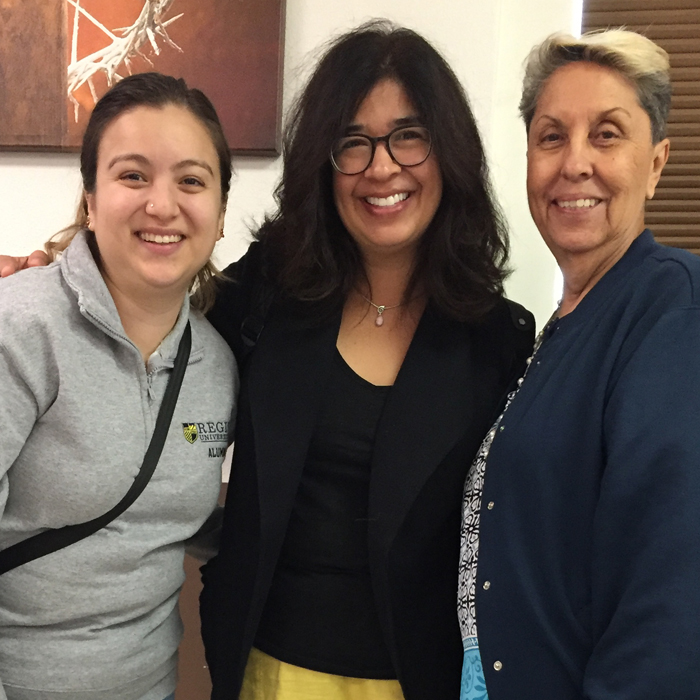
Magali Martinez, Nicki Gonzales, PhD (Vice Provost for Diversity
and Inclusion, and Professor of History at Regis University)
and Martha Del Real share a laugh.


Frank Okoren and his 98-year-old father, Rudy. Rudy entertained his granddaughter Karina by reciting escapades from his childhood.

It wasn't all hymns and history. There were tales of church founders arrested for bootlegging. Rudy Okoren recalled the Mass being said in Latin, with a sermon in Slovenian and a sermon in English. He smiled when confessing to skipping the second homily to steal a smoke. There were memories of altar servers, choirs, the terror of receiving your report card and a Christmas pageant with the Baby Jesus going airborne. We had such a great time, we'll do it again Saturday, March 25th, 2023.

View those entertaining stories on our YouTube Channel


https://youtu.be/GAMeDnK2kZc


Thursday, November 10, 2022

Elections in Globeville

The very first election in Globeville was held on a Thursday, July 2, 1891. The community needed to decide whether or not to incorporate their settlement.

Developers had laid out inexpensive, rural-sounding tracts so workers could build homes close to their industrial jobs. Greenwood Addition, Cranberry Place, Tacoma Heights, Argo Park, Platte Farm and Garden Place were growing in population and this vote was to determine whether their residents wanted to incorporate as a single town. Thomas J. Anders, a real estate developer from adjacent Retreat Park, opposed the idea and argued that taxes would likely increase. But many citizens were concerned that their village could be annexed by Denver (who coveted the tax revenue from the smelters and meat packing plants), by the straight-laced company town of Argo to the west, or the anything-goes town of Elyria to the east. 

Residents felt the need for some civic improvements like water treatment, fire and police protection, street lights, and control over the kind of behavior that would be tolerated in the town. Incorporation carried the day and the community chose the name of "Globeville" for their new city.

An organizational meeting was held in the Globeville schoolhouse at 51st and Washington with homesteader William Hanford Clark chosen as the town's first mayor. Attendees decided that the city government would be elected every two years and consist of the mayor, six trustees, a recorder, treasurer, magistrate and marshal. Officials wold meet every second Tuesday of the month at 7:30 pm, with additional meetings as necessary.

The minutes of that first meeting reflect the determination of the council to ensure that Globeville would be a desirable place to live. Prize fighting, which was legal and profitable in nearby Elyria, was forbidden. "Abusive, common, vulgar, indecent or improper language was illegal, as well as inciting others to commit violent crimes."

The neighborhood still had large areas of open land and town ordinances reflected that. "The running of large horses, cattle, sheep or goats, geese or burros within the limits of the town is illegal."

The first meeting dealt with the structure of governance in Globeville and it was decided to hold the first official election of officials and trustees in the spring. So a ballot for the vote was published on April 1, 1892, in the Rocky Mountain News, and the election held on April 5, 1892. 


Monday, September 12, 2022

Holy Rosary Homecoming - October 8, 2022

You don't have to be a current parishioner (although you are always welcome) - you just have to love Holy Rosary. Were your grandparents married here? Was anyone in your family baptized here? Did any of your family attend school or church at Holy Rosary? Sing in the choir? Act in a school play? Attend religious education classes? What teachers do you remember? Did you go to the church bazaar? Enjoy our monthly pancake breakfasts?

Join us on Saturday, October 8th for Homecoming!

We'll begin with Mass at 10:00 am, and then convene in the cafeteria to share coffee, pastry and memories. Bring your photos, scrapbooks, notebooks, recipes, posters, and stories. (You might even discover a distant relative).

There will be a video set up in the small classroom near the cafeteria where you can share a memory of your family, a favorite teacher or what Holy Rosary meant to you.

RSVP maryloudesign@comcast.net

So we can have enough food!

Row 1: Irene Horvat, Anna Mae Canjar, Mary Jane Grande, Monsignor Judnic, Fernand Cain,
Dorothy Gilmour, Dorothy Meyer, Margaret Kucler.
Row 2: Lucille Franks, Joseph Pavlakovich, Albert Angerer, Harold Nothaft,
Stephen Shinall, Joseph Yelenick, Steffie Okoren. 


Teacher Mrs. Nancy Jackson and husband Bob Jackson