Showing posts with label Boston and Colorado. Show all posts

Tuesday, August 16, 2016

Nathaniel P. Hill - Boston and Colorado Smelter

Most photos of Nathaniel P. Hill show the mature businessman, distinguished-looking U.S. Senator and publisher of the Denver Republican Newspaper. But it was the thirty-two-year old Hill who pioneered smelting methods and saved Colorado's fledgling mining industry.

A professor of chemistry at Brown University in Providence, Rhode Island, young Hill was already a rising star in scientific and business circles when he was contacted by mining men and investors in the Colorado territory to solve a problem with ores.

Gold had been discovered in Colorado in the fall of 1858, and fortune seekers rushed to the territory the following spring, finding "free gold" - nuggets and flakes - in their sluice boxes. But most of Colorado's valuable minerals were not "free" but bound up in complex ores. Without a method to economically separate minerals from the sulfides and bromides that trapped them, mining was fruitless. By 1864, the territory faced a crisis as prospectors and investors withdrew their money, mines closed, camps were deserted and settlements evaporated.

Hill arrived in Central City in 1864, intrigued by the challenge, but also attracted to the West as the place to make a name for himself. Hill observed first hand the problems of separating gold and silver from complex sulfide ores and methodically investigated various European smelting technologies, settling on a process developed in Swansea, Wales. With four other investors, Hill organized the Boston and Colorado Smelting Company in Black Hawk and by 1868 the smelter was in operation. 

For ten years, the Boston and Colorado was the only smelting operation in the Rockies to attain both technical and financial success, with production growing from $271,000 in 1868 to $2,260,000 in 1878. By 1878, the company needed to expand and relocated to an area of high ground between west 44th and 48th Avenues and Delaware to Fox Streets, taking advantage of the nearby Colorado Central and Denver Pacific Railroads. The Boston and Colorado built a company town known as Argo, and many people referred to the smelter as the Argo Smelter. (in Greek mythology, Argo is the name of a ship whose captain, Jason, hopes to find the golden fleece and claim his inheritance). The success of the plant prompted the construction of two smelters nearby: the Omaha and Grant in 1882 and the Globe Smelter in 1889.

Hill’s achievements led to a political career: he was elected mayor of Black Hawk in 1871, then Colorado‘s Republican Senator from 1879 to 1885, serving on the Committee on Mines and Mining and advocating for free coinage of silver. After his term ended, Hill purchased the Denver Republican newspaper to promote Republican causes. 

Hill's business success is well known, but his relations with his employees differed from that of his competitors. During the national recession of 1893, both the Grant and Globe Smelters closed, laid of workers and waited for economic conditions to improve. When those plants reopened, new hires were forced to take a 10 to 15 percent reduction in pay, leading to resentment, unrest and strikes. During the same period, Hill reduced his own salary, but not that of his employees saying that he could stand the loss better than they could.* (Because the Boston and Colorado processed ores containing gold, the plant was able to operate without layoffs). Hill's employees never joined the Mill and Smeltermen's Union.

Hill died in Denver on May 22, 1900 and is buried at Fairmount Cemetery. 

*“Did Not Cut Wages at Argo Smelter in 1893 and Said He Could Stand Loss Better Than Men.” Denver Times, June 13, 1899

Senator Nathaniel P. Hill, photo Matthew Brady

Boston and Colorado Smelter at Argo, photo Denver Public Library

Hill residence at 14th and Welton,
built in 1884. photo Denver Public Library
 

Saturday, November 13, 2010

Argo Park

The Rocky Mountain News described Argo Park as “…a delightful retreat on the banks of the Platte…whose grounds have been prettily laid out… a charming suburban retreat.” The occasion was the dedication of the park on July 25, 1880, a decade before Globeville existed as a town. The park, which extended from Logan Street on the West to Washington Street on its eastern edge, was intended to serve the residents of Argo, the company town built by the Boston and Colorado Smelter, as well as the citizens of Denver. Philip Zang purchased the “resort” in January, 1885 and made improvements that included a theater, dance pavilion, bowling alley, ball fields and a small zoo. The park was home to the Strawberry Festival, picnics, band concerts, athletic activities, community gatherings and “pleasure parties of all kinds.”1. Welsh workers from the Boston and Colorado Smelter held annual eisteddfods, or singing contests, in remembrance of customs in their native land.
Martha Kulik Birch remembered, “It was one block square and they had a dance pavilion with an orchestra. People used to work hard all week and then come on the streetcar and dance under the stars. 
In the summer, there were swings, sandboxes, and a little cement wading pool for us kids. When I was about nine or ten [1917], we had this wonderful, husky teacher named Mrs. Roosevelt who wore a middy blouse, a big skirt, and carried a big whistle. We kids never ran wild because everyone obeyed her. She showed us how to make baskets by soaking rattans, and at the end of the summer, we each had a little basket.”2.
The park diminished in size as various owners sold parcels for development, and became part of the Denver parks system when Globeville was annexed in 1902. As part of the New Deal, a swimming pool and changing rooms were added in 1940, and a memorial honoring Globeville veterans killed in World Wars I and II was dedicated on August 25, 1948. More recent improvements have included a lighted baseball and softball field, basketball court, playground, and picnic tables. The pool underwent $1 million in renovations in 2005, a “sprayground” was added in 2007 and walking path in 2014.


1. Rocky Mountain News, July 25, 1880
2. An interview with Martha Kulik Birch with her niece Debbie Strein.
3. Fell, James E., Jr. Ores to Metal: The Rocky Mountain Smelting Industry. Lincoln: 
University of Nebraska Press, 1979
4. www.recreationparks.net/CO/denver/argo-park-denver
Top photo, Miss McCammon taught the third and fourth grades - 
photo of her class taken in 1914 with the dance pavilion in the background. 
Photo used with written permission from Minnie Boge Herbert.
Middle and bottom photos, Argo Park today, Mary Lou Egan

Wednesday, May 12, 2010

Argo School


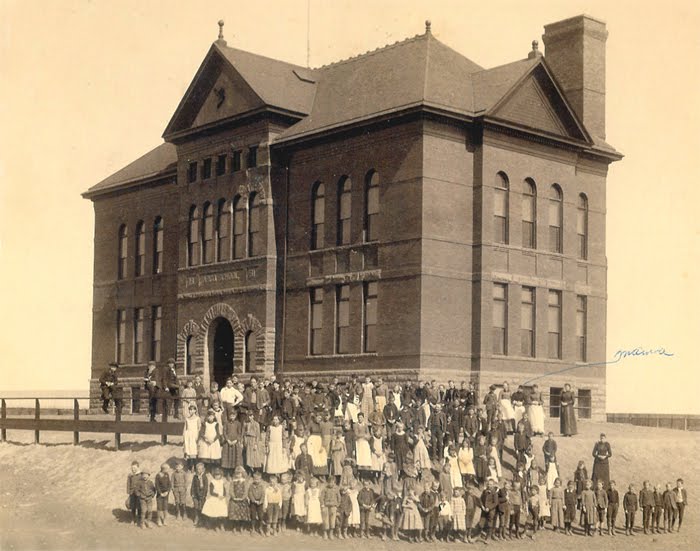
At the time of Globeville’s incorporation in 1891, four elementary schools, Argo, Ironton, Globeville and Garden Place, served the area's children. The Argo School was built in 1890 for the children of the company town known as Argo, home of the Boston and Colorado Smelter. The school was richly endowed with funds from the smelter and the railroads and embodied all that was modern in its day: toilets that flushed, a basement, and a furnace. The school also housed the office of the superintendent, who was responsible for all four schools.
After a fire destroyed the Boston and Colorado Smelter in 1906, the population of the town diminished, the smelter was dismantled, and the school torn down in 1916. The convergence of interstate highways known as the "Mousetrap" occupies the site of the once-massive smelter, and the Plaza Hotel (now the Quality Inn) at 48th Avenue and Broadway occupies the site of the Argo School.
Photo of the Argo School about 1891 courtesy of Nora Landberg Duryea.
Photo of Plaza Hotel, Mary Lou Egan.