Each day, thousands of commuters pass ASARCO's Globe Smelter site with hardly a second glance at the Globeville landmark. Built in 1886, the plant operated first as a smelter that separated valuable metals from raw ore, then as a producer of specialty metals. The company closed in 2006, and plans for remediation and development of 77-acre complex are now moving forward. The many buildings and structures now being dismantled provide a glimpse of a 120-year-old company with an interior life of its own.
High, wire-topped fences surround the site and it's difficult to see all the buildings, but Steve Stevens, Safety and Personnel Manager from 1967 to 1988 recalls many of them."The tall building housed the Godfrey Roaster that roasted low-grade products from Amarillo and from Leadville, and East Helena, Montana. And there was the unloading building, the bag house, the calcine building, the tank house, and the solution department. They also had the retort department where they purified the metal, and the cadmium sulphide department where they made the paint pigment for cadmium yellow. There was the thallium department, the indium department, the litharge department, the casting department, the premelt room, the change house, the respirator room, the laundry room and the locker room.
"The two-story home near the 51st Street entrance to the plant was the superintendent's house from the old days when he lived on the property. The house contained an old safe with 'Globe Smelting and Refining' written on it. There are also ledgers with the names of employees - Slovenians, Croatians, Poles, Germans, Russians and some Hispanics - from a time when there were three shifts running seven days a week.
"In the old days, we used to have a garden right on the property and we grew vegetables. And we had a baseball team and played for the championship in 1948 at Overland Park, beating Central Bank one to nothing."
Long gone is the housing provided by the company: the 125-room Globe Hotel for single men and the 10 or 12 houses along Sheedy Row, with accommodations for families. And there was the Globe Mercantile where men could cash their paychecks and purchase everything from food to bicycles.
"A lot of guys were very grateful for jobs at the Globe because they were able to raise a family and buy a house."
It is hoped that the clean up of the site will also offer jobs and the opportunity for families to settle in Globeville.
Showing posts with label smelter. Show all posts
Monday, February 13, 2012
Ghost of ASARCO
Labels:
ASARCO,
clean up,
ghosts,
Globeville,
history,
remediation,
smelter,
Washington Street
Tuesday, April 19, 2011
Heritage of Smelting
"Joint project expected to provide hundreds of jobs upon completion," the headline in the Metro Denver Economic Development newsletter gushes. The story describes plans to redevelop the former ASARCO site at 51st and Logan, all that remains of the important and powerful industry that once defined Globeville.
The story begins with the discovery of gold and silver in Colorado in 1858 and the "Rush to the Rockies" that followed, bringing hordes of fortune seekers to the territory. A crisis developed as business leaders realized that the mineral wealth was untouchable unless the metals could be separated from the complex ores that held them - settlers were leaving and eastern investors were withdrawing funds. What followed was a quest to find an economical, efficient and reliable method for recovering minerals - the region's survival was at stake. Entrepreneurs, businessmen, scientists and charlatans proposed remedies, but it was a professor of chemistry from Brown University, Nathaniel P. Hill, who found the solution and opened the Boston and Colorado Smelter near Black Hawk in 1867.
The smelter was wildly successful and soon outgrew its canyon location, moving in 1878 to a hill north of Denver and close to the Colorado Central and Denver Pacific Railroads. The new plant covered six acres between what is now West 44th and 47th Avenues, and Fox to Pecos Street. 350 men, mostly English, Welsh, Irish, Scotts and Swedes worked at the Smelter. The Boston and Colorado organized a classic company town, with three hotels for single men, houses for families and several company stores. The village was named Argo, after the mythical ship sailed by Jason in search of the golden fleece, and people soon referred to the smelter by the same name.
The firm's success lead to the construction of more smelting operations in the area, the Omaha and Grant in 1882 and the Globe in 1886. Changes in technology, and the depletion of the state's mineral-rich ores made the Boston and Colorado Smelter obsolete by 1902. A fire in the smelter's refinery in 1906 spelled the end of the smelter and the town of Argo, but the legacy of mining and refining lives on in the neighborhood in the remains of ASARCO's Globe plant. Again, there is a promise of jobs in processing and reprocessing the earth's minerals.
The "mousetrap" occupies the smelter's location today
Photo of the Boston and Colorado Smelter, Colorado Historical Association
The story begins with the discovery of gold and silver in Colorado in 1858 and the "Rush to the Rockies" that followed, bringing hordes of fortune seekers to the territory. A crisis developed as business leaders realized that the mineral wealth was untouchable unless the metals could be separated from the complex ores that held them - settlers were leaving and eastern investors were withdrawing funds. What followed was a quest to find an economical, efficient and reliable method for recovering minerals - the region's survival was at stake. Entrepreneurs, businessmen, scientists and charlatans proposed remedies, but it was a professor of chemistry from Brown University, Nathaniel P. Hill, who found the solution and opened the Boston and Colorado Smelter near Black Hawk in 1867.
The smelter was wildly successful and soon outgrew its canyon location, moving in 1878 to a hill north of Denver and close to the Colorado Central and Denver Pacific Railroads. The new plant covered six acres between what is now West 44th and 47th Avenues, and Fox to Pecos Street. 350 men, mostly English, Welsh, Irish, Scotts and Swedes worked at the Smelter. The Boston and Colorado organized a classic company town, with three hotels for single men, houses for families and several company stores. The village was named Argo, after the mythical ship sailed by Jason in search of the golden fleece, and people soon referred to the smelter by the same name.
The firm's success lead to the construction of more smelting operations in the area, the Omaha and Grant in 1882 and the Globe in 1886. Changes in technology, and the depletion of the state's mineral-rich ores made the Boston and Colorado Smelter obsolete by 1902. A fire in the smelter's refinery in 1906 spelled the end of the smelter and the town of Argo, but the legacy of mining and refining lives on in the neighborhood in the remains of ASARCO's Globe plant. Again, there is a promise of jobs in processing and reprocessing the earth's minerals.
The "mousetrap" occupies the smelter's location today
Photo of the Boston and Colorado Smelter, Colorado Historical Association
Friday, June 4, 2010
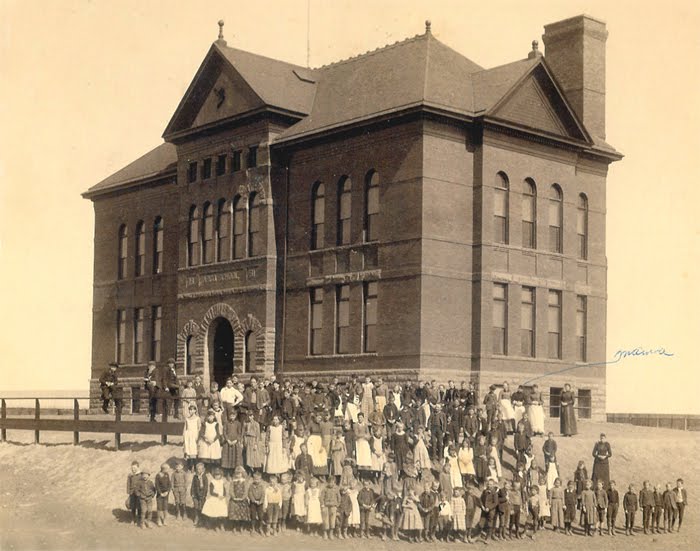
The Globeville School


Three large smelters, the Boston and Colorado, the Omaha and Grant and the Globe, operated in Globeville between 1878 and 1889 and workers moved to the town seeking jobs. As the population grew, the region evolved from a rural outpost to an industrial village and the small country schools that dotted the area became inadequate. The Globeville School was built on the corner of 51st and Washington in 1890 on land belonging to the Globe Smelter, replacing a one-room country school that had been on that site since the 1870s. The community continued to expand and a new and larger Globeville School was completed in 1925 at 51st an Lincoln. However, the increase in the population reached its high point in the 1920s and declined afterward. With a dwindling enrollment, the Globeville School closed in 1943 and the remaining students were sent to Garden Place School.
In 1948, the building was given new life when Joseph and Elizabeth Calabrese created Laradon Hall, an organization that offers support, guidance and training to children with developmental disabilities.
Top photo, Globeville School at 51st and Washington, 1890, photo Denver Public Library
Second photo, Sam's Vintage Parts occupies the remains of the 1890 school, photo Mary Lou Egan
Third photo, new school 51st and Lincoln 1923, photo Denver Public Library
Fourth photo, Laradon Hall today, photo Mary Lou Egan
Labels:
1890,
business,
Globeville,
Laradon Hall,
schools,
smelter,
Washington Street
Wednesday, May 12, 2010
Argo School


At the time of Globeville’s incorporation in 1891, four elementary schools, Argo, Ironton, Globeville and Garden Place, served the area's children. The Argo School was built in 1890 for the children of the company town known as Argo, home of the Boston and Colorado Smelter. The school was richly endowed with funds from the smelter and the railroads and embodied all that was modern in its day: toilets that flushed, a basement, and a furnace. The school also housed the office of the superintendent, who was responsible for all four schools.
After a fire destroyed the Boston and Colorado Smelter in 1906, the population of the town diminished, the smelter was dismantled, and the school torn down in 1916. The convergence of interstate highways known as the "Mousetrap" occupies the site of the once-massive smelter, and the Plaza Hotel (now the Quality Inn) at 48th Avenue and Broadway occupies the site of the Argo School.
Photo of the Argo School about 1891 courtesy of Nora Landberg Duryea.
Photo of Plaza Hotel, Mary Lou Egan.
Labels:
48th Avenue,
Argo,
Boston and Colorado,
education,
Globeville schools,
Mousetrap,
smelter
Subscribe to:
Posts (Atom)