Showing posts with label Poland. Show all posts

Friday, February 19, 2016

Polish National Alliance, St. Martin's 134


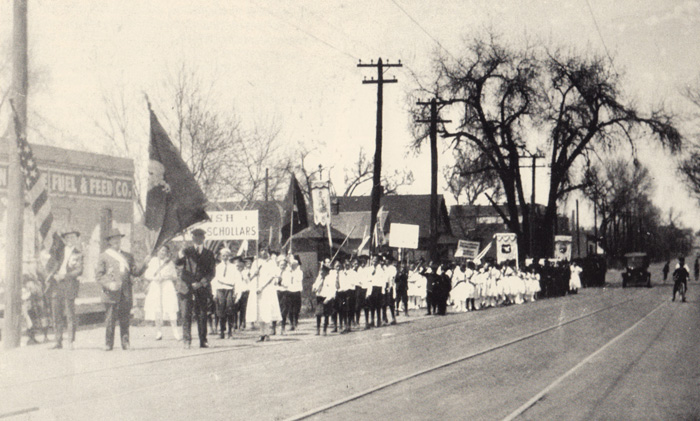
The storefront behind the Polish scout troop seems much larger in the 1935 photo than it does now. Today, the structure at 4839 Washington is encased in stucco and devoid of any defining features, but was once home to St. Martin's Society, Group 134 of the Polish National Alliance and the gathering place for Globeville's Polish community for over a century. Globeville's lodge, founded on October 5, 1889, was a branch of the national society headquartered in Chicago. The organization offered sick and death benefits, financial services, fellowship for Polish immigrants, as well as enlightenment about their rights and obligations as American citizens.
In addition to providing a financial safety net for families, PNA was committed to preserving Polish heritage by celebrating Polish Constitution Day on May 3rd, Corpus Christi during June, and the special foods and culture of their partitioned homeland. There were activities for every age group and demographic: the Polish Falcon Nest 712, a group practicing physical fitness and para-military training; the St. Adalbert's Society, a coed society for young adults; the Polish Falcons baseball team; and the Polish Harmony Club, for young adults who enjoyed singing and dancing. Globeville's Poles maintained connections to other Polish communities in larger cities like Chicago, and the towns of Pueblo, Trinidad, Walsenburg, Starkville and Rockdale in Colorado through the PNA newspaper, Zgoda,(Harmony). The lodge was instrumental in the establishment of St. Joseph's Polish Catholic Church in 1902, and its parochial school in 1926. 
With the coming of New Deal programs like Social Security, improvements in workplace safety and other avenues for health insurance, fraternal lodges lost much of their importance. American-born children were less committed to preserving their Polish heritage, and had many other opportunities for social activities than those offered by PNA. After World War II, the descendants of the Polish pioneers had moved to new homes in the suburbs and visited Globeville and St. Joseph's Church only for holidays or funerals. After the breaking up of the Soviet Union, new arrivals from Poland attend St. Joseph's Church, but celebrate their heritage at the Polish Club of Denver.
Although the Polish National Alliance no longer has an active organization, the society left its imprint on the Globeville neighborhood in St. Joseph's parish. 


Monday, February 4, 2013

Historic churches in Globeville

Shot-gun houses fill the long, narrow lots, iron and wooden fences define each yard and sheds, re-purposed chicken coops and barns line the unpaved alleys. Economically, Globeville is a poor neighborhood, but historically, tiny Globeville is rich. Each small home contains the story of an immigrant with a low-paying job, sending for relatives from the Old Country and building a better life in America. Hard-working and painfully frugal, these newcomers saved and planned for a generation to build their own ethnic churches, a link to their native cultures and a celebration of the freedom of worship that brought many here. By 1920, the neighborhood was home to three Volga-German congregations, a Russian-Serbian Orthodox Church, St. Joseph's Polish Roman Catholic Church, Holy Rosary Church, the Greenwood Methodist and the Seventh Day Adventist Churches. As the founders passed on and their descendants assimilated and moved away, congregations would struggle and not all the churches would survive
As the remaining parishes reached milestone anniversaries, parishioners experienced a renewed interest in their ethnic heritage, and looked for ways to celebrate their legacy with official historic status. Three of Globeville's ethnic churches have received historic designation: St. Joseph's Polish Roman Catholic Church is on the National Register, while both Holy Transfiguration Cathedral and Holy Rosary Parish are on the Colorado State Register. St. Joseph's at 517 East 46th Avenue, was listed on the National Register of Historic Places in 1983.
The listing from the National Register states that "the Gothic style church was constructed in 1902 to serve Polish immigrants in the Globeville suburb of Denver." What the description doesn't say is that Globeville's Poles were from the Russian-controlled Plock region of Poland, where their religion, language and culture had been suppressed, that they would save for nearly 20 years, and then petition the German-born Bishop Matz to build a parish "exclusively for the Polanders." The congregation obtained Father Jarzynski (a Holy Cross priest from the same Plock region as many parishioners) and held Mass, confession, baptism and marriages in the home of Frank Wargin until the church was completed on Christmas Day, 1902. The church was a connection to Poland at a time the nation had ceased to exist, and much of the life of the Polish community was centered around St. Joseph's. There were processions for the feast of Corpus Christi, blessings of food before Easter, as well as Mass after the secular celebrations of Polish Constitution Day and the birthday of Casimir Pulaski. There was the Polish Literary Club, an organization for young people, that produced Polish plays, raising money for the parish and entertaining the community. There were also choirs, music performances, fraternal organizations, mock Polish weddings and parish bazaars.
The parish survived the Depression, World War II, assimilation, the division of the neighborhood by interstate highways and inadequate services from the city of Denver to make it for 110 years. With an infusion of new arrivals from Poland and enthusiastic support from the descendants of the founders, St. Joseph's is again the source of Polish culture, with Masses in both English and Polish, Polish language classes, Polish music and dance performances. Visit the website, or stop by (Lent is coming!) and experience the rich faith, food, culture and traditions of Poles in Globeville.  
St Joseph's Polish Roman Catholic Church


Funeral at St. Joseph's circa 1910, Photo® property of Mary Lou Egan


St. Joseph's circa 2013, photo® property of Mary Lou Egan