Showing posts with label Polish Hall. Show all posts

Friday, February 19, 2016

Polish National Alliance, St. Martin's 134


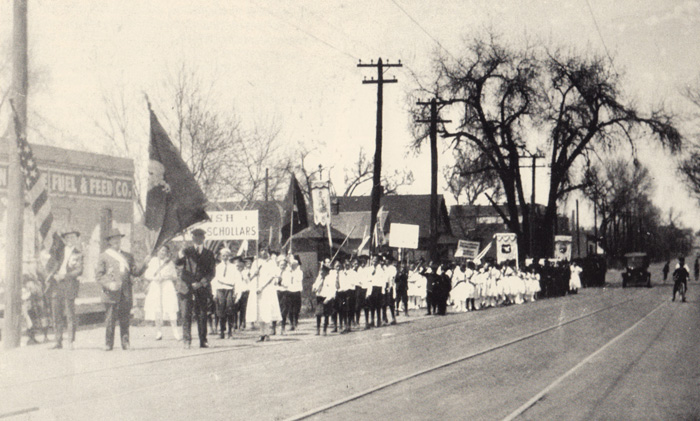
The storefront behind the Polish scout troop seems much larger in the 1935 photo than it does now. Today, the structure at 4839 Washington is encased in stucco and devoid of any defining features, but was once home to St. Martin's Society, Group 134 of the Polish National Alliance and the gathering place for Globeville's Polish community for over a century. Globeville's lodge, founded on October 5, 1889, was a branch of the national society headquartered in Chicago. The organization offered sick and death benefits, financial services, fellowship for Polish immigrants, as well as enlightenment about their rights and obligations as American citizens.
In addition to providing a financial safety net for families, PNA was committed to preserving Polish heritage by celebrating Polish Constitution Day on May 3rd, Corpus Christi during June, and the special foods and culture of their partitioned homeland. There were activities for every age group and demographic: the Polish Falcon Nest 712, a group practicing physical fitness and para-military training; the St. Adalbert's Society, a coed society for young adults; the Polish Falcons baseball team; and the Polish Harmony Club, for young adults who enjoyed singing and dancing. Globeville's Poles maintained connections to other Polish communities in larger cities like Chicago, and the towns of Pueblo, Trinidad, Walsenburg, Starkville and Rockdale in Colorado through the PNA newspaper, Zgoda,(Harmony). The lodge was instrumental in the establishment of St. Joseph's Polish Catholic Church in 1902, and its parochial school in 1926. 
With the coming of New Deal programs like Social Security, improvements in workplace safety and other avenues for health insurance, fraternal lodges lost much of their importance. American-born children were less committed to preserving their Polish heritage, and had many other opportunities for social activities than those offered by PNA. After World War II, the descendants of the Polish pioneers had moved to new homes in the suburbs and visited Globeville and St. Joseph's Church only for holidays or funerals. After the breaking up of the Soviet Union, new arrivals from Poland attend St. Joseph's Church, but celebrate their heritage at the Polish Club of Denver.
Although the Polish National Alliance no longer has an active organization, the society left its imprint on the Globeville neighborhood in St. Joseph's parish. 


Friday, May 3, 2013

May 3 - Polish Constitution Day

On May 3rd, the trees are bare, the weather cool and overcast, but for Globeville's Poles, nothing could dampen their enthusiasm for Polish Constitution Day, a day to demonstrate their national pride. The festivities would begin with Mass, followed by a parade with all the Polish fraternal organizations, glee clubs and dramatic societies marching down Washington Street, and culminating in an afternoon of food, patriotic speeches, singing and story telling. Members of nearby churches and fraternal lodges would also attend, as well as local politicians (particularly if an election was near). With celebrations like Polish Constitution Day, Poles would keep their homeland alive even as the nation itself had been nearly erased.
In the late 18th century, the Republic of Poland had been carved up by its powerful neighbors, Russia, Prussia and Austria. The next 100 years saw a relentless attack on the nation's identity, with each of the conquering powers restricting the Polish language, culture and religion, and requiring young men to serve in the armies of their oppressors. Seeking political and religious freedom, as well as economic opportunity, Poles began to emigrate to America, arriving in Globeville during the 1880s. 
In Globeville, Poles would form fraternal organizations to care for each other and perpetuate their heritage, and despite their limited financial means, build St. Joseph's Polish Catholic Church and School. Poles would relish the freedom to celebrate the Feast of Corpus Christi in June, the birthday of Casimir Pulaski in October, and the Christmas and Easter traditions dear to them.
Today, the Polish nation is again alive and Polish culture in Globeville is vibrant and robust, continued at St. Joseph's Polish Catholic Church and School.
St Joseph's Polish Catholic Church
Krakowiacy Polish Dancers


Polish Constitution Day, circa 1941
photos used with written permission from Jan Gisewski Garland


Sunday, July 1, 2012

Polish Heritage Continues in Globeville

Poles began arriving in the area that would become Globeville in the 1880s before the town was incorporated in 1891. Seeking jobs in the Argo, Grant and Globe Smelters, a small number settled in the 4500 to 4800 blocks of Washington, Pearl, Pennsylvania, Logan and Grant Streets, and on Emerson Street near the Platte River. Poles were never as numerous as the other groups who arrived in Globeville but they made their presence known by establishing fraternal organizations that would provide assistance in the event of injury, illness or death - common occurrences in smelters. There was St. Martin’s Society, Lodge #134, of the Polish National Alliance founded in 1889 and Group 62, St. Joseph’s Society of the Polish Union of North America organized in 1897. In addition to these insurance organizations, Poles formed the Polish Literary Club, the Polish Harmony Club and the Polish Falcons, all social groups for young adults. All the organizations worked to build St. Joseph's Polish Catholic Church in 1902 and the school in 1926. All these institutions had the preservation of Polish culture as an integral part of their existence, hoping to convey that heritage to the next generation.  
As Poles succeeded in improving their lot financially and providing a better life for their children, they moved out of the Globeville neighborhood. (construction of two interstate highways through the heart of community accelerated their exodus.)
But Polish culture lives on in Globeville at St. Joseph's Polish Catholic Church, with Mass in both English and Polish, and celebration of traditions such as the Corpus Christi procession through the neighborhood. Classes in the Polish language are taught at the school, and Polish choirs and the Krakowiacy dancers hold regular performances.


Krakowiacy singers

Altar for Corpus Christi Procession

St Joseph's Polish Catholic Church

http://www.krakowiacy.net/