Tuesday, April 19, 2011

Heritage of Smelting

"Joint project expected to provide hundreds of jobs upon completion," the headline in the Metro Denver Economic Development newsletter gushes. The story describes plans to redevelop the former ASARCO site at 51st and Logan, all that remains of the important and powerful industry that once defined Globeville.
The story begins with the discovery of gold and silver in Colorado in 1858 and the "Rush to the Rockies" that followed, bringing hordes of fortune seekers to the territory. A crisis developed as business leaders realized that the mineral wealth was untouchable unless the metals could be separated from the complex ores that held them - settlers were leaving and eastern investors were withdrawing funds. What followed was a quest to find an economical, efficient and reliable method for recovering minerals - the region's survival was at stake. Entrepreneurs, businessmen, scientists and charlatans proposed remedies, but it was a professor of chemistry from Brown University, Nathaniel P. Hill, who found the solution and opened the Boston and Colorado Smelter near Black Hawk in 1867.
The smelter was wildly successful and soon outgrew its canyon location, moving in 1878 to a hill north of Denver and close to the Colorado Central and Denver Pacific Railroads. The new plant covered six acres between what is now West 44th and 47th Avenues, and Fox to Pecos Street. 350 men, mostly English, Welsh, Irish, Scotts and Swedes worked at the Smelter. The Boston and Colorado organized a classic company town, with three hotels for single men, houses for families and several company stores. The village was named Argo, after the mythical ship sailed by Jason in search of the golden fleece, and people soon referred to the smelter by the same name. 
The firm's success lead to the construction of more smelting operations in the area, the Omaha and Grant in 1882 and the Globe in 1886. Changes in technology, and the depletion of the state's mineral-rich ores made the Boston and Colorado Smelter obsolete by 1902. A fire in the smelter's refinery in 1906 spelled the end of the smelter and the town of Argo, but the legacy of mining and refining lives on in the neighborhood in the remains of ASARCO's Globe plant. Again, there is a promise of jobs in processing and reprocessing the earth's minerals.


The "mousetrap" occupies the smelter's location today
Photo of the Boston and Colorado Smelter, Colorado Historical Association


Tuesday, March 29, 2011

The Denver & Interurban

The headline in the Denver Post proclaimed “Beautiful Boulder Is Now Within 55 Minutes of Denver,” and the story that followed described clean, efficient passenger service on low-cost, electric trains. The article was not about some imaginary light rail system of the future, but an enthusiastic report of the inaugural run of the Denver & Interurban Railroad of June 23, 1908. The Denver & Interurban was worthy of some excitement, providing service every hour between Denver and Boulder with stops at Globeville, Westminster, Broomfield, Louisville, and during the summer, the resort of Eldorado Springs. The Denver Post continued “the electric cars can attain the speed of a mile a minute. . . and passengers are not annoyed with cinders, smoke and dust.” The fare was fifty cents.

The line operated from the Denver Tramway’s Interurban Loop at 15th and Arapahoe Streets, which made it easy for passengers to transfer from any of the city’s streetcar lines. From there, the train traveled to the 23rd Street viaduct, past the Interurban shops at 36th and Fox and east on 45th Avenue to Washington Street in Globeville.
The Globeville station was a small building at 5125 Washington, rented from owner John Bohte for $25 a month. Ed Wargin recalls “If we wanted to go to Eldorado Springs, we’d buy our tickets at the station. It was a store-front kind of a thing with a big old pot-bellied stove.” 
Globeville was the edge of the Denver city limits and the place where the switch was made from the tramway connector to the overhead electrification system, the pantograph. It was also the scene of the line’s only major wreck, when two cars collided on Labor Day 1920, killing 12 and injuring 214. The holiday may have contributed to the disaster; the cars were overloaded and the motormen called in to handle the extra crowds were inexperienced.
The cars involved in the wreck were restored, but the Interurban suffered financially from the settlements awarded to the survivors. After World War I, cars were more affordable, highways were improved and more people wanted to drive. The Interurban electric cars ceased operations in 1926.

The Kite Route, Story of the Denver and Interurban Railroad, William C. Jones and Noel T. Holley, 1986 Pruett Publishing Company, Boulder, Colorado
Interview with Ed Wargin

Interurban station is at the right on Washington Street, about 1913
Lower photo shows the ticket office at 5125 Washington Street, Juarez Auto Sales today


Tuesday, March 8, 2011

Nicknames in Globeville

Globeville was (and is) like a small town where everyone knew everyone else, a familiarity evident in the many nicknames given to people.
Joseph Yelenick remembered, "Everyone down here had a nickname. There were 'Buck' and 'Beans' Oletski, 'Dutch' Maier, 'Alias' Stefanski, 'Stash' (Stash is Polish for Stanley) Slovenski, 'Butch' Lunka, 'Too-tall' Vuksinich, 'Hawk-eye' Evanitich (because he couldn’t see very well), and 'Goose-eye' McGahan (because he was a great shot). Andy Jackson was 'Stonewall Jackson' because he had a military posture. There was a kid who played football in Wyoming that had such a long last name that they just called him 'Joe Alphabet'. There was 'Oogie' Ungehire, Johnny 'Chink' Horvat, and 'Butch' and 'Moose' Horvat."
Larry Summers added. "Cocky Spomer was a little fellow and that’s why they called him 'Cocky'. John Dreith was called 'Peggy' because he had a bad leg and Harold Schaffer was called 'Shugs'”.
 "Gas-pipe" Joe Grabrian was a plumber and "lead-pipe John" Predovich managed the Polish Hall. John Wysowatcky was known as "Smitty" and Father Jarzynski as "Father Jar." 
The nicknames were good-natured and well-meaning fun in a tight-knit community.


Top photo, John "Smitty" Wysowatcky
Bottom photo, Andy "Stonewall" Jackson


Sunday, February 20, 2011

Matthew E. Eagleton

The distinguished-looking man in the back row of the 1913 class at Garden Place School is Matthew E. Eagleton, principal from 1901 - 1920, and one of three Eagleton brothers who devoted their lives to schools in Denver.* When he began his career in 1901, Eagleton was in charge of three schools Argo, Globeville and Garden Place, driving a horse and buggy from one school to the other. 
Eagleton was respected by the immigrant community, helping parents with the process of Americanization and holding citizenship classes in the evenings. The teachers at Garden Place admired "Mr. Eagleton, who did everything in his power to make things easier for us...getting supplies and books." He inspired teachers to fill the educational gaps for children who were out of school for several months to work in the beet fields. When Globeville's German-Russian population came under suspicion during World War I, Eagleton defended their patriotism, reminding public officials there were "72 service stars on the service flag, two of which are gold." Matthew E. Eagleton died in February, 1920, leaving his widow (and Garden Place teacher, Maude Long) and a grateful community.
*Brothers J. S. and W. H. Eagleton were also educators and principals in Denver.
 History of Garden Place School, typed manuscript 1950
1913, Picture used with written permission from Maxine DeDonato


Tuesday, February 1, 2011

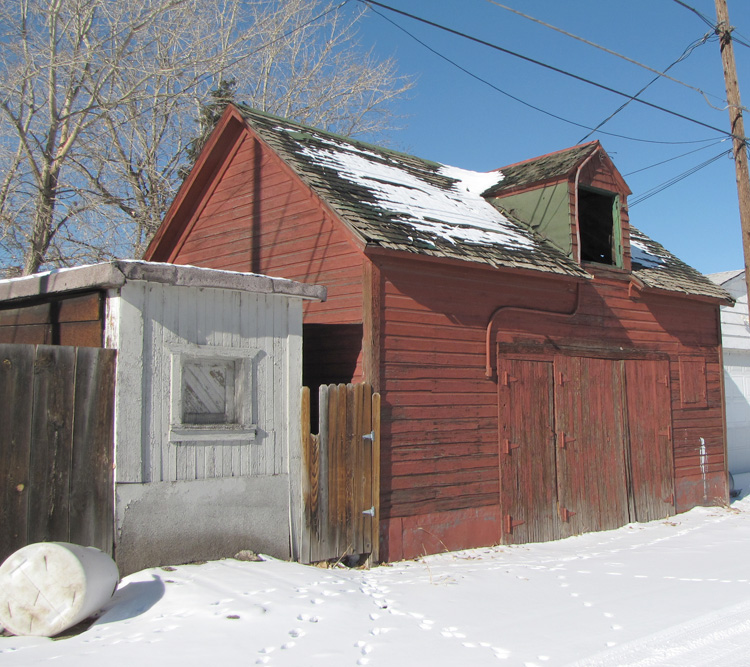
Barns and Sheds

Early Globeville was more rural than urban and many people built a barn in the back for chickens, geese, cows, horses, wagons and storage. Lumber as well as paint could be obtained at the nearby Burlington shops, giving these buildings a distinctive look - tongue and groove wood painted "railroad red." As Globeville evolved, so did the use of these outbuildings - from barns to garages, workshops and mother-in-law apartments. Many of these structures survive - a tribute to the craftsmanship and enterprise of the pioneer builders, and an additional bit of charm in a neighborhood with personality to spare.


Photos, Mary Lou Egan

Saturday, January 15, 2011

Wolgagesangbuch

There were three German-Russian churches in Globeville whose congregations were composed (mainly) of people who from the same villages in Russia. The Congregational Church was founded by immigrants from the village of Norka, St. Paul’s Church by people from the village of Beideck, and the Friedens Evangelical Church by people from Doenhoff. Though belief varied a little, all three congregations used the same hymnal, the Wolgagesangbuch, with hymns being a conspicuous and important part of worship.

Lydia Heck remembered, “They were long songs, sometimes fifteen verses, and people knew them by heart. Those books had the words in them, but no music.” John H. Werner recalled, “I believe most of the people knew practically all of the 878 songs in the book from memory! Some of the favorites that come to mind are: Allein Gott in der Hoeh, Christi Blut, Ein Fester Burg Ist unser Gott, and Jesu, Geh Voran.
With prosperity and assimilation, the German-Russian population of Globeville moved away from the neighborhood, but their descendants inherited their faith - a faith based on the Bible, a personal relationship with God and a simple lifestyle.

Wolgagesangbuch courtesy of Virginia and John Laber

http://heritagecommunity.net/
www.ahsgr.org

Sunday, January 9, 2011

Developments at Holy Rosary Parish

Red, white and blue bunting emphasizes that the Slovenian and Croatian immigrants are loyal to their new country, while lodge banners proclaim their determination to preserve the heritage of the home country. The stack from the Grant Smelter looms over the Globeville neighborhood and women hold umbrellas to ward off the hot sun. August 17, 1919 was the day on which the cornerstone of Holy Rosary Church at 4688 Pearl Street was blessed by Bishop J. Henry Tihen "in the presence of a great crowd of rejoicing people." These immigrants were proud of their new parish and devoted their time, treasure and talent to the church. Founding pastor, Father Cyril Zupan, O.S.B., was responsible for both Holy Rosary Parish and St. Mary's Parish in Pueblo, which meant a two-hour train ride each way to say Mass, administer the sacraments and supervise construction.

90 years later, the parish faces new challenges. Pastor Noé Carreón is charged with the task of restoring the church, convent and school and rebuilding both English-speaking and Spanish-speaking congregations. Although the task is great, Father Noé, the parishioners and the neighborhood are excited to see the progress that has been made.
The parish invites you to follow our journey on our blog/website at:
http://holyrosarydenver.com