Monday, May 9, 2016

Swedes in Globeville

Most Swedes immigrating to America arrived in the period after the Civil War and settled in the Great Lakes states and the northern Great Plains particularly in Minnesota, Michigan, Illinois and Wisconsin. Unlike the eastern European newcomers, Swedes were not fleeing religious persecution but were attracted by the farmland available under the Homestead Act of 1862. Swedes were also lured to the west by the Colorado gold rush, and found jobs in mines and smelters in Black Hawk, Central City, Pueblo, Leadville, Cripple Creek, Aspen and Ouray.
When Colorado's first successful smelter, the Boston and Colorado, built a plant north of Denver in 1878, the company employed Scots, Welsh, Germans, Irish, English and a large number of Swedes. In the company town of Argo, Inca Street was referred to as Smaland Avenue because so many residents came from that region of Sweden. Swedes also found jobs in the Omaha and Grant, and Globe Smelters, railroads, brickyards, foundries and meat packing plants in Globeville.
Swedes formed numerous self-help societies like the Skandia Benevolent Order in 1876, as well as social groups like the Republican Club, the Swedish-American Silver Club, a Scandinavian-gymnastic club, music society, theatrical troupe, hospital organization, publishing company, and Swedish versions of the Red Men, Knights of Pythias, Odd Fellows, and American Foresters. There were seven Swedish-language newspapers in Colorado between 1882 and 1944 with Svenska Korrespondenten (published from 1889 to 1901) being the most widely read with branch offices in Pueblo, Leadville and Cripple Creek.
The Swedish Lutheran or the Union Swedish Church in nearby Argo provided a spiritual home within walking distance of Globeville; the Bethany Swedish Evangelical Lutheran Church (at 32nd and Gilpin Street), the First Swedish Methodist Episcopal (in 1890, located at 1924 Pennsylvania), or Swedish Lutheran Church at 23rd and Court Place also held services for Swedes.
Although Swedes were never numerous enough to have a church or lodge building in Globeville, their culture added a distinctive flavor to the neighborhood.

Bethany Swedish Evangelical Lutheran Church at 32nd and Gilpin Street

Swedish Lutheran Confirmation Class about 1914 

Swedish workers from the brickyards


Friday, April 8, 2016

Bilingual Globeville

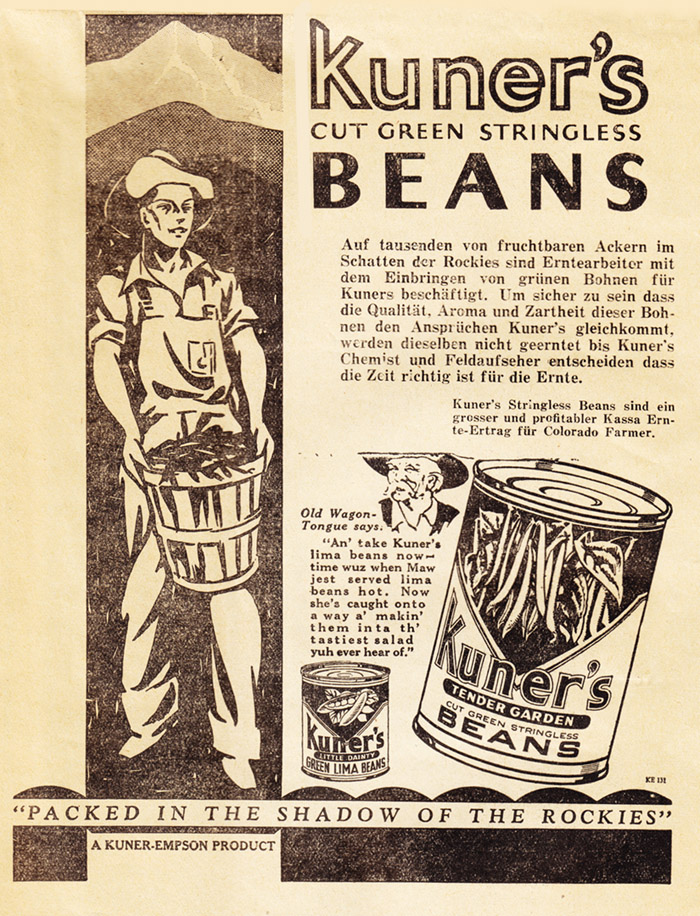
If you lived in Globeville before World War II, you would hear older people speaking in their native Polish, Slovenian, Croatian, Russian, Slovak, Czech and the distinctive German spoken by the Volga Deutsch. Many spoke a combination English and the language from the Old Country, or could speak well enough but weren't able to read and write in English. Businesses and ethnic newspapers recognized the situation and responded with graphics, and dual-language copy. Here are a few samples of local advertising that appeal to the consumer in his own language.


Got the message - butter top and cakes.


Before Colorado went dry in 1916, Martinitz and Sons had a saloon at 3455 Blake Street.
Perhaps the remedy offers an alcohol content and buzz that takes your mind off your ailments.


Combination German and English "Customer Parking Building"


1930 ad for Tuner's Cut Green Beans


Friday, February 19, 2016

Polish National Alliance, St. Martin's 134


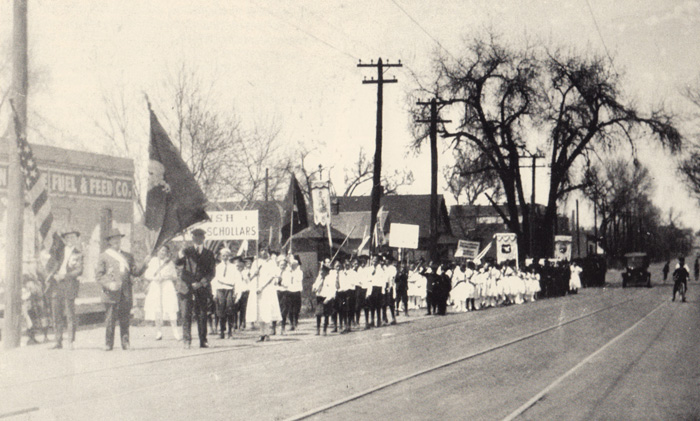
The storefront behind the Polish scout troop seems much larger in the 1935 photo than it does now. Today, the structure at 4839 Washington is encased in stucco and devoid of any defining features, but was once home to St. Martin's Society, Group 134 of the Polish National Alliance and the gathering place for Globeville's Polish community for over a century. Globeville's lodge, founded on October 5, 1889, was a branch of the national society headquartered in Chicago. The organization offered sick and death benefits, financial services, fellowship for Polish immigrants, as well as enlightenment about their rights and obligations as American citizens.
In addition to providing a financial safety net for families, PNA was committed to preserving Polish heritage by celebrating Polish Constitution Day on May 3rd, Corpus Christi during June, and the special foods and culture of their partitioned homeland. There were activities for every age group and demographic: the Polish Falcon Nest 712, a group practicing physical fitness and para-military training; the St. Adalbert's Society, a coed society for young adults; the Polish Falcons baseball team; and the Polish Harmony Club, for young adults who enjoyed singing and dancing. Globeville's Poles maintained connections to other Polish communities in larger cities like Chicago, and the towns of Pueblo, Trinidad, Walsenburg, Starkville and Rockdale in Colorado through the PNA newspaper, Zgoda,(Harmony). The lodge was instrumental in the establishment of St. Joseph's Polish Catholic Church in 1902, and its parochial school in 1926. 
With the coming of New Deal programs like Social Security, improvements in workplace safety and other avenues for health insurance, fraternal lodges lost much of their importance. American-born children were less committed to preserving their Polish heritage, and had many other opportunities for social activities than those offered by PNA. After World War II, the descendants of the Polish pioneers had moved to new homes in the suburbs and visited Globeville and St. Joseph's Church only for holidays or funerals. After the breaking up of the Soviet Union, new arrivals from Poland attend St. Joseph's Church, but celebrate their heritage at the Polish Club of Denver.
Although the Polish National Alliance no longer has an active organization, the society left its imprint on the Globeville neighborhood in St. Joseph's parish. 


Tuesday, January 19, 2016

Globeville Discovery Day

Do you have information that could help us tell Globeville’s story? Stop by and share your memories and historical knowledge about your neighborhood. Information you provide can help the Discover Denver project communicate what makes Globeville, and Denver, special.
If you have old photographs of the Globeville neighborhood, or even of your own house, we’d love to have you bring them to this event. We’ll have equipment on hand to scan photographs and to capture stories. Stop by and socialize with your neighbors, and share stories and memories about Globeville. Refreshments will be provided.

Globeville Discovery Day
Saturday, February 6th, 10 am-1 pm
Holy Transfiguration of Christ Church Hall
349 East 47th Avenue, Globeville
 Discover Denver is a project focused on identifying historic and architecturally significant buildings citywide.
Historic Denver, Inc. and the City and County of Denver are partners in this effort, which is
funded primarily through a Colorado State Historical Fund Grant.
For more information visit www.DiscoverDenver.co, or call 303-534-5288 x3.

¿Tiene información que podría ayudarnos a contar la historia de Globeville? Venga y comparta sus recuerdos y conocimientos históricos sobre su barrio. Información que usted proporcione puede ayudar al proyecto Descubra Denver comunicar lo especial de Globeville, y Denver.
Si tiene fotografías antiguas del barrio Globeville, o incluso de su propia casa, nos encantaría que las traiga a este evento. Tendremos el equipo a la mano para escanear fotografías y capturar historias.
Pase por el evento y converse con sus vecinos y comparta historias y recuerdos de Globeville. Se proporcionarán alimentos.
Globeville Día de Descubrimiento
Sabado, 6 de febrero, 10 am-1 pm
Holy Transfiguration of Christ Church Hall
349 East 47th Avenue, Globeville

Descubra Denver es un proyecto enfocado en la identificación de edificios históricos y arquitectónicamente importantes
en toda la ciudad. Denver Histórico, Inc. y la Ciudad y Condado de Denver son copatrocinadores de este esfuerzo,
cual se financiado principalmente a través de una beca del Fondo Histórico de Colorado.
Para obtener más información, visite www.DiscoverDenver.co, o llame al 303-534-5288 x3.

Tuesday, January 5, 2016

Little Christmas tradition in Globeville

Globeville's early settlers practiced Christmas traditions from the old country, providing a source of comfort and connection to familiar traditions in their new circumstances. For many, St. Nicholas Day on December 6th meant setting out shoes or hanging a stocking the night before and discovering a small treat, an orange or candy, in the morning. For the Volga Germans, Poles, Slovenes and Croats, Christmas Day was reserved for attending church, visiting family, sharing a meal, exchanging modest gifts and remembering family left behind.
For Greek Uniate and Orthodox Slavs, Christmas Day was a religious holiday, but it was the feast of the Epiphany on January 6th, and the adoration of the infant Jesus by the three kings that was celebrated in a big way. Gifts were exchanged in remembrance of the gold, frankincense and myrrh brought by the Magi, and homes were blessed in honor of the three kings' visit to the home of the Holy Family. After the house had been blessed, the names of the kings, Gaspar, Melchior and Balthasar, were written on the back of the door in chalk.
For Hispanics in Globeville, the 6th day of January, El Dia de Los Reyes, is also an important tradition. The kings pay tribute to the infant redeemer, bring small gifts to delight children and continue a custom many remember from Mexico.

The Magi visit the Holy Family at Holy Rosary
Holy Rosary Parish


Thursday, December 31, 2015

Peter Nazarek and Nettie Homyak wedding photo

In 2014, K Stone wrote, "I recently discovered your blog, Globeville Story. My great-grandfather, Panko Homyak, is mentioned in your post, “Historic Holy Transfiguration of Christ Cathedral.” He was one of the church founders. I have been doing genealogy research and recently received from a distant cousin a November 1901 wedding photo, of a wedding that likely took place in that church. Panko Homyak is in the photo (far right), as a witness. We know the identity of one of the couples, but do not know who the other two couples are. The couple in the center is Peter Nazarek/Nazaryk and Mastazia Chomjah (Nettie Homyak). We contacted the church, but many church records were lost in a flood. I wonder if you would consider posting the photo on your blog, asking if any of your readers can identify those people?"
Some observations: Since the church was founded in 1898, this wedding would have been performed by Father Nicholas Seregelly, a Greek Catholic priest. In the Denver city directory of 1896, Panko Homyak is listed as a cigar maker and may explain his holding cigar in a wedding photos. Is Nettie his daughter? Why is Panko's wife not in the photo?
Does anyone have any information about these couples?
 
The wedding couple in the center is Peter Nazarek (Nazaryk) and Mastazia Chomjah (Homyak),
and the man on the far right (holding the cigar) is Panko Homyak.
The wedding took place November 3, 1901. Probably at Holy Transfiguration of Christ Orthodox Cathedral, then called Greek Catholic Church, Transfiguration of Christ

Tuesday, December 29, 2015

Stories to tell - Discover Denver

Janet Tekavec Wagner explains, “My great grandfather, Conrad Jacoby, and my grandfather John Jacoby, built this house at 4438 Lincoln Street, across from Garden Place School. The entire family, adults and children, worked in the sugar beet fields. My mother, Leah Jacoby, and her four brothers were born there. After they married, my mom and dad, Joe and Leah Tekavec, lived there. I was born in that house. Long after we sold the house in 1990, people still referred to it as the ‘Jacoby House’.”
Every building has a story to tell and Globeville's houses, businesses and churches have been gathering tales for over a hundred years. Do you know the history of your home? Would you like to? Discover Denver, a building and neighborhood survey means to identify historic and architecturally structures citywide. Led by Historic Denver in partnership with the City and County of Denver and History Colorado, the survey will gather information using public records, academic research, neighborhood canvassing, and tips from the public. Findings will be accessible online so that everyone can learn the stories form the buildings in their neighborhood.
To find out more, access survey reports from pilot areas, to volunteer, or offer information about your home, business or church in Globeville, visit www.discoverdenver.co/ or contact bglandon@historicdenver.org
Far right, Janet’s grandmother Mary (Claus) Jacoby holding baby Floyd Jacoby.
Man on porch is her father Conrad Claus, and middle woman is Mary’s sister.
Photo about 1915. Used with written permission from Janet Wagner.

Jacoby house about 1938.
Used with written permission from Janet Wagner.

4438 Lincoln summer, 2014
® Mary Lou Egan